
Well. Here we are.

Mike Donovan finds Martin’s tour of the mothership is a little different from John’s.
In the previous two posts we examined the lead up to high Nazism and how this inspired V. We considered the road to power for a totalitarian regime. In this post we consider to what end?
Today we are metaphorically standing in the bowels of the mothership next to our hero Mike Donovan staring at thousands of capsules of humans to be harvested for food. What the hell happened?
The horror of alien cannibalism is a plotline clearly intended to shock by breaking a serious human taboo. I think the reason this needed to be this shocking was to try to recapitulate the shock the Allies experienced when they liberated Europe and saw for the first time the full horror of what had really been going on in concentration camps and extermination centres. A horror we are sadly a little numb to now through exposure.
I mentioned before that modernism and eugenics were highly influential forces within Germany, particularly within the medical profession. I also mentioned that I studied medicalisation of murder in Nazi Germany so it should be no surprise that we end up here.
Here being where it all started. Tiergartenstraße 4 in Berlin.

Tiergartenstraße 4 home of the Aktion T4 euthanasia programme
Eugenicist ideas were commonly taught to medical students (notably to Josef Mengele who was a product of this education system. We will look at Mengele in more detail when we discuss the character inspiration for Diana). Prevalent within the medical profession at the time was the idea that the German nation was like a single organism, one from which the sick elements should be excised. This is horrific enough in theory but the Nazis took this thinking very literally and began to target those that they believed were Lebensunwertes Leben: life unworthy of life.
It was here where the gas chamber was developed and its use carefully honed. If V were set in 1930s Nazi Germany the moment of awful truth would be this: Martin would be a junior doctor showing Donovan the bodies of euthanised children with mental and physical disabilities instead of people in stasis pods.
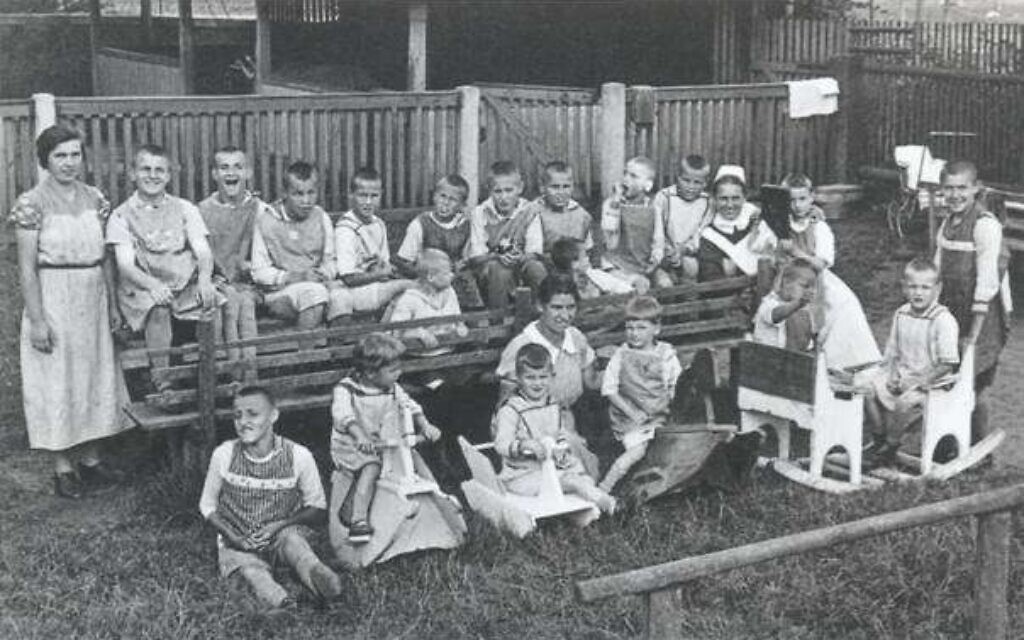
Patients at Katharinenhof c.1939/40
(Many of whom were subsequently killed during Aktion T4)
The scary thing is the ideas underpinning these horrendous actions (which were met with disgust and distress by the relatives of the euthanised) was not that far out there for it’s time. In particular, eugenics was very popular in the United States and there was plenty of academic exchange between nations on the topic at the time. Sterilisation laws introduced by the Nazis in Germany were based on precedents set in the United States making it far less easy to dismiss eugenics as a German aberration.
In The Nazi Doctors: Medical Killing and the Psychology of Genocide Robert Jay Lifton argues that forced sterilisation is the acceptable entrée for applied eugenics, which for the Nazi doctors led to a gradual erosion of morals to the point they are an integral part of the murder machinery at extermination centres like Auschwitz-Birkenau.
It was doctors who were responsible for deciding who was fit for slave labour and who wasn’t. With a flick of a doctor’s wrist millions were sent to the gas chambers because they were too old, too young, too infirm, too pregnant, maternal or generally female. This was purification of the German body politic reduced to its most base form.
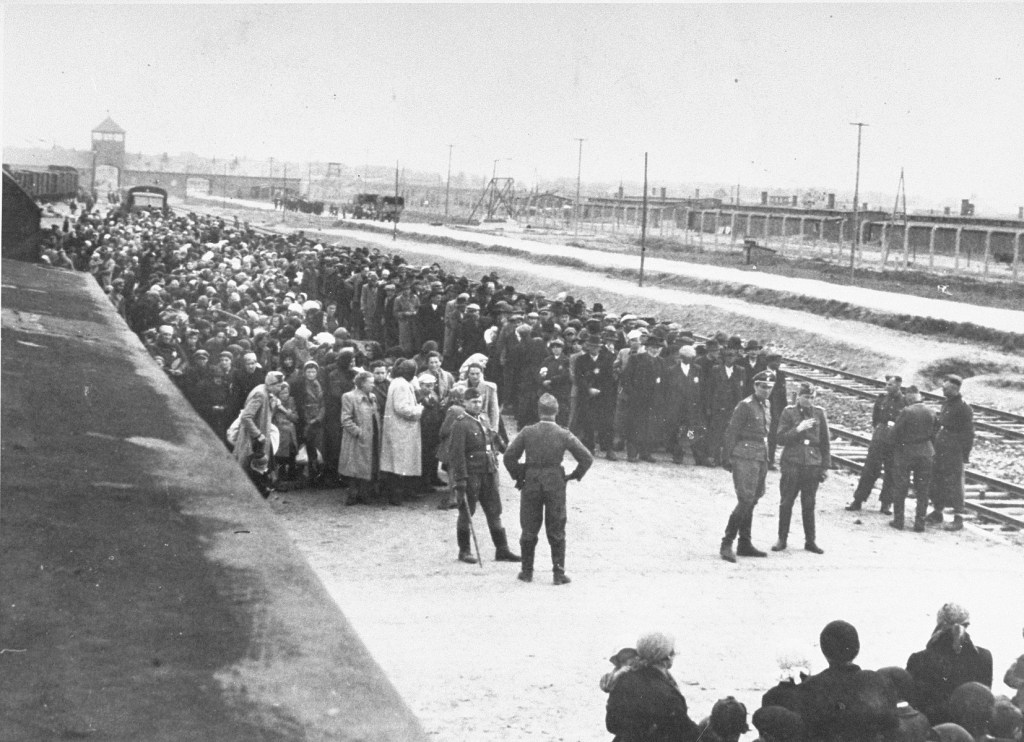
Selektion (for the gas chamber) at the Auschwitz railhead. Two queues separate men from women and children. It’s unconfirmed but the man holding a cigarette on the right is possibly Josef Mengele.
We can only guess as to how the aliens in V arrived at this point where they thought it was totally okay to round up and enslave millions of humans. At first you can see Martin trying to rationalise things a little bit because he says some of them will be soldiers. But when pressed you can see the shame on his face as he explains most will end up as food. Any bets on for whether there will be a Visitor doctor deciding who among the human cargo is strong enough to be forced into military service once they get back to the home planet? (Hint: it won’t be the old, the young, the infirm … or most women.)
It is actually quite fitting that Johnson decided to go with the concept of technologically advanced aliens from outer space as an allegory for totalitarianism. (It is well known that his original concept was to do a straight drama about a totalitarian force coming to power in America and that he almost threw his toys when the network said “yeah good, but how about making the baddies alien lizards?”) I’ve mentioned modernism a few times already. Nazism wedded ideology with technical advancement. They approached the Final Solution as a technological and psychological problem. Specifically how do you get people to agree to kill thousands. And how do you get people to calmly go to their deaths.
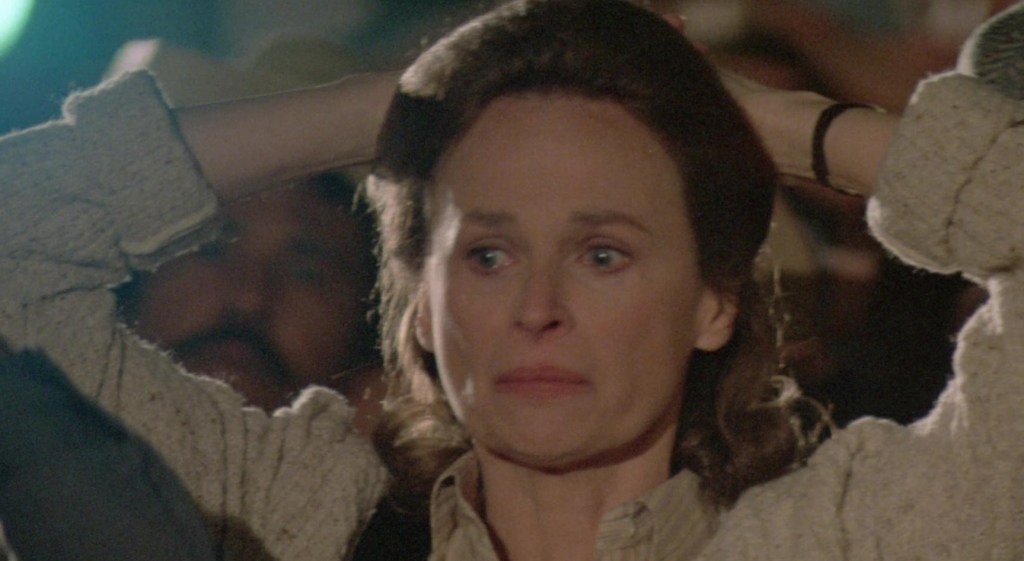
A terrified Lynn Bernstein is rounded up after her own son Daniel dobs her in.
There was an evolution from gas chambers at Tiergartenstraße to the mobilisation of genocide via gas trucks to the building of extermination centres in Treblinka, Chemnitz and Auschwitz-Birkenau. At the same time there was the evolution of the Einsatzgruppen, a specialised para-military death squad. These were the guys who would come to your shtetl, round everybody up, make the men dig a mass grave and then shoot everyone and push them into it.
To support all of this the Nazis were masters of euphemism, hiding evil deeds by giving words new meaning – “final” and “special” being favourites. Final Solution is a euphemism for genocide, Sonderkommando (special command) a cruel name for the prisoners responsible for manning the gas chambers and crematoria. (For a gruelling but moving depiction of the life of someone in the Sonderkommando I recommend Son of Saul by Hungarian director László Nemes. Accurate and difficult film but worth it.) Note that in V this euphemistic language is also adopted by the Visitors, specifically when Diana and Martin discuss sending Donovan to the “Final Area”.
Against this backdrop V explores the question “what would you do?” in this situation. In a previous post we talked about levels of complicity. There we noted that if people like the Dupres’ weren’t exactly at the graveside pulling the trigger, nevertheless they were certainly benefiting from it. But there were others within Nazi Germany who were more than complicit.
For many years the received wisdom about the Final Solution was the SS were entirely culpable. Other armed forces such as the Wehrmacht supposedly were not involved. This was a convenient way of dealing with the mess of people floating around Europe after the collapse of the German state. If you were an American or British soldier you could tell if someone was a baddie because they wore the SS deaths head and a blood type tattoo under their arm (required of every SS man). This idea was very persistent for a long time and would have been prevalent when V was first made.
Since then scholarship has moved on. There are multiple works that cover this but I’ll point out a couple. Daniel Goldhagen’s Hitler’s Willing Executioners highlighted how much “ordinary Germans” particularly the Wehrmacht were involved in the Final Solution. This was controversial when first published but widely accepted today. This is corroborated by Neitzel Sönke and Harald Welzner’s whose Soldaten: On Fighting Killing and Dying gives unique and fascinating insight into the thoughts and feelings of various German armed forces at the time.
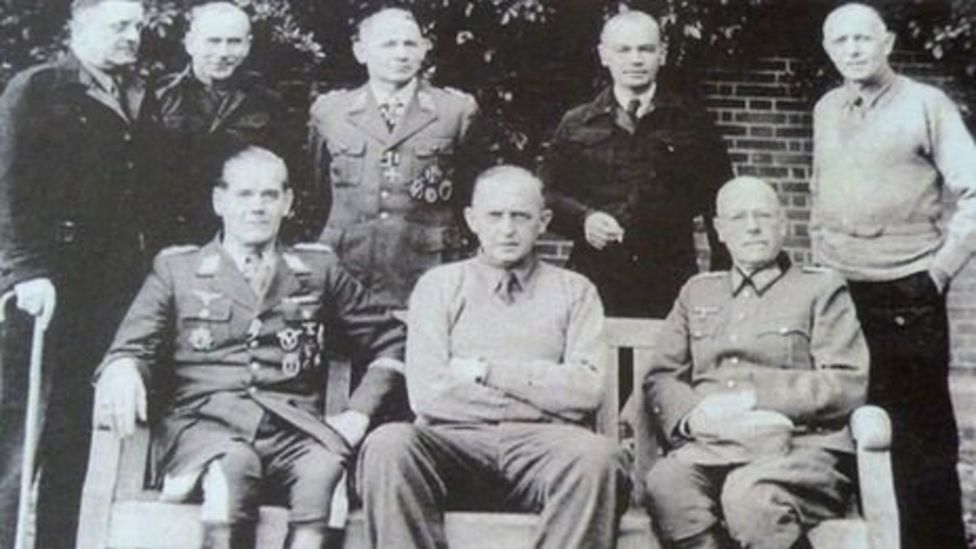
German Generals at Trent House where the mammoth listening-in project was undertaken
This book is based on hours and hours of transcripts of conversations between German forces held as POWs in Britain during the war. Unbeknownst to the POWs, their conversations were recorded (the surveillance used by their captors was quite remarkable) translated and used as intelligence by the Allies. These men were put up in extremely comfortable accommodation (think class politics of La Grande Illusion) and arrogantly thought they could speak freely about anything and everything among themselves.
It is from these transcripts that it becomes clear just how much involvement various armed forces had in mass executions of Jewish people in Eastern Europe. It was quite common for the Einsatzgruppen to invite whoever was around, whatever military, police or security forces, were there at the time to “have a go” at shooting innocent men, women and children graveside. What’s more, these things were quite public events which some townsfolk turned up to watch for entertainment. I believe Soldaten is compulsory reading for any student of this period in history but I’ll go easy on you and suggest you don’t read it all in one sitting. You may never look at soldiers – any soldiers – the same way again.
On this sadly I think V is a little weak, more so The Final Battle than the original miniseries. Essentially, war is generally not good. (Remember Tolstoy? Ok. I’m not saying he was a pacifist but he didn’t believe that war is intrinsically a force for good either.) The issue which perhaps never had the chance to be considered is what does fighting a totalitarian regime do morally to those fighting it?
During WWII the Allies were certainly guilty of sliding into less and less upstanding decisions such as carpet bombing civilian populations in Germany, notably Dresden and Hamburg. This was driven by a determination to win the war by any means necessary to stop the evil which was Nazism in Europe and Japanese Imperialism in the Asia-Pacific. But at what cost to defeat evil?
This ultimately ends in Hiroshima and Nagasaki, the need for which was highly questionable. (In 1946 The New Yorker gave over all its pages to John Hersey’s eye witness account and it is harrowing but necessary reading for any WWII history buff.) But because the victims were the enemy, and Japanese (an “alien race” no less) no one thought too heavily about it.
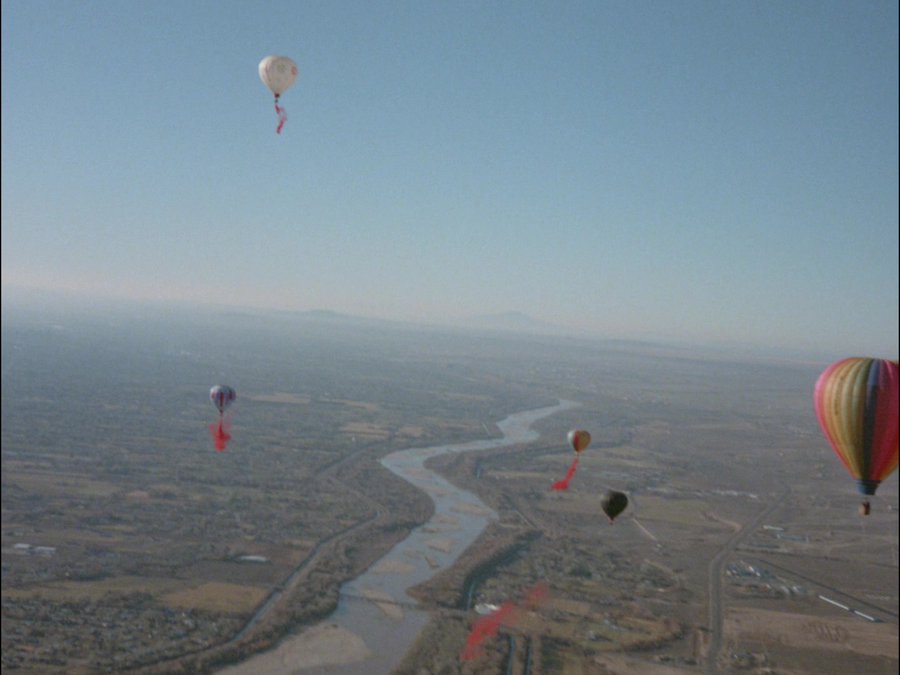
Look at the pretty balloons and don’t think too hard about what’s really going on here.
The same is true with the introduction of the red dust in The Final Battle. Yes, yes I know – H.G. Wells. But in War of the Worlds, the bacteria as a weapon arose organically, no one designed it. (BTW War of the Worlds was an allegory for German invasion as after 1871 there was much paranoia in Britain about German imperialism which I discussed in the first post of this series.)
The thing that potentially puts the brakes on this plan is the threat of nuclear annihilation, not the consideration that using germ warfare against the Visitors is tantamount to genocide. No one ever considers that in their desperation to drive the Visitors from our planet the Resistance have come to make decisions that resemble the very evil they are trying to fight. (For contrast a movie that does a good job of exploring this topic is the Danish film Flame and Citron about real life Danish resistance fighters in WWII.)
No one comes out of war totally unscathed. People have to make great sacrifices to fight for a cause, something V tells us from its very establishing shot. I do feel if Johnson had stayed on board more of this tone would have made it through to The Final Battle. This is the biggest strength of the original series: the appreciation for resistance fighters no matter when or where they are from.

To all Resistance Fighters, past, present and future.
We’ve looked mainly at V in comparison with Nazi Germany and WWII, but in the next post we’ll take a look at some of the more speculative historical connections.
 When Martin Died