
This post is the second in a series considering connections between history and V. In the previous post we looked at the Napoleonic Wars and War and Peace. And we took the most facile and glib examination of German history possible without actually being a History Channel war documentary. Today we’re going to look at how fascism took root in Germany. Just like in V, which was largely inspired by this period in history.
Fun fact: “Nazi“ was a pejorative term used by their opponents, it was a play on words shortening National Socialism, but Nazi is also a diminutive of the name Ignatz, which at the time had the same cultural currency as the name Karen has today. No one at the time would ever refer to themselves as Nazis because it was a term used by upper and middle classes to sneer at those they believed to be ignorant and uncouth. It drives me bonkers when I watch a movie that has National Socialists call themselves Nazis because it would never have happened.
Now I’ve got that off my chest, let us begin.

“The stab in the back” a.k.a. The Treaty of Versailles
We left Germany at the end of the First World War just at the beginning of the Weimar Republic. This was a well-meaning attempt by those that won WWI to bring democracy to Germany. You can imagine how well Germans reacted to this interference from foreign powers, especially when you couple this with requirements for Germany to demilitarise as well as paying economically crippling reparations bills. Because everyone loves foreign powers sticking their noses in and telling you how to run your country.
Enter politics as expressed through street violence! Hurrah! Now this fact is very different to V, where politics in late 20th century America are expressed in a more genteel fashion, mostly via television and telegraphed through consumerist choices such as what newspapers people read (note Juliet Parish’s vacuous boyfriend reads The Wall Street Journal) and political parties people vote for (Julie is clearly a Republican, Mike Donovan is likely a Democrat if he votes at all – he may choose impartiality as a member of the press. Hard to believe I know).
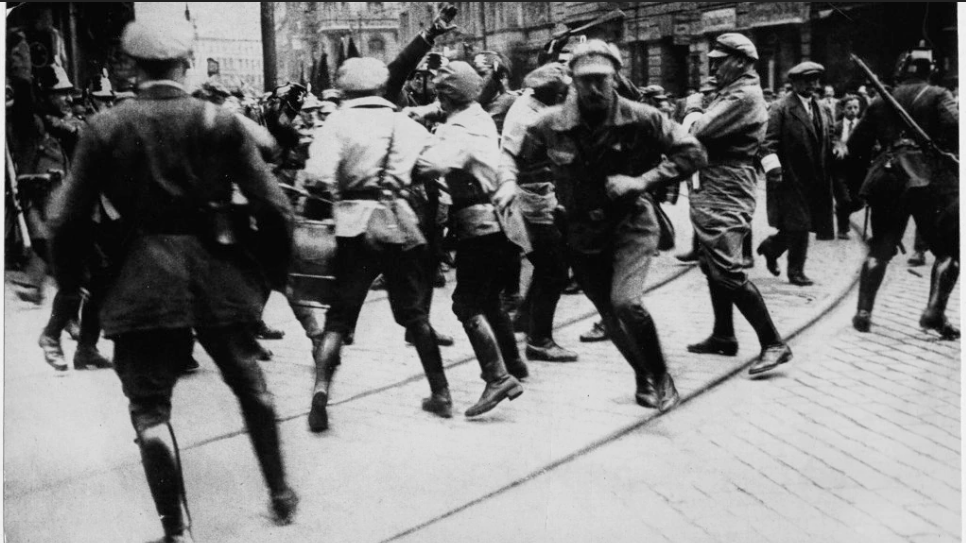
Blutmai (Bloody May) 1929
Communist rioting in Berlin, was repressed by the local constabulary
So in Germany the economy was a wreck, there were loads of unemployed angry men around with plenty of time on their hands. At this point in the 20th century the first generation to benefit from universal education was coming of age and literacy was at an all time high. It seems strange, but reading as a pastime was really a thing back then because people didn’t have anything competing for their attention like cellphones, gaming consoles or TV or even radio which was not yet ubiquitous. Self education was big, this was the best time in history to be an auto-didact. Populism was therefore huge. I would highly recommend the series The People’s Century if you want to know more. This is a truly exciting period in history. This gave many populists opportunities to reach people not just through oratory and meetings but also text (like Mein Kampf and The Little Red Book).
The other dominant force at this point was modernity. Modern and modernist ideas. Social sciences had come to the fore and there were many new ideas emerging about human psychology, sociology and anthropology. Anthropology’s dirty secret is that is was so closely connected with the eugenics movement.
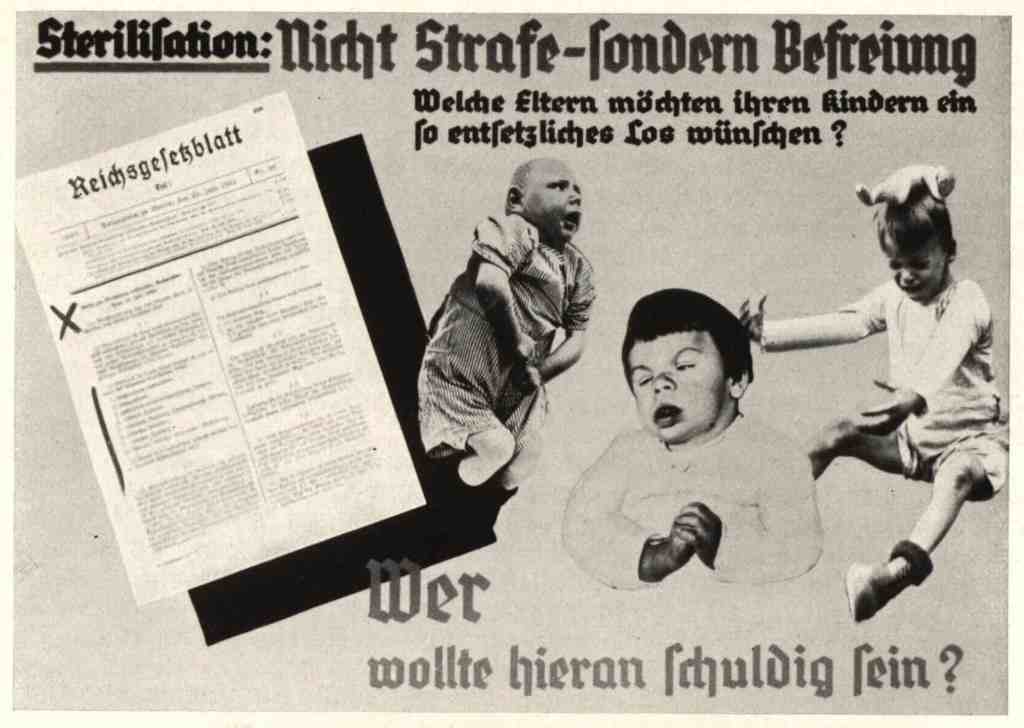
Children with mental and physical illnesses are presented in the most grotesque way possible. Caption says: “What parent wishes such a life upon their children? Who wanted to be guilty of this?“
As an undergraduate in anthropology I was told when I got to my third year I would have to write a dissertation on the history of anthropology. It could be on any topic I liked. Except eugenics. So I left the Anthro department for History to study the medicalisation of murder in Nazi Germany. I’ve been suspicious of anthropology since then, even though I hear things have changed and the field is more open to self-criticism now.
It is therefore highly ironic to me that Robert Maxwell, the character that inspired me to take and interest in anthropology in the first place, is so cruelly targeted in V.
Politics in Germany in the Weimar Republic was expressed violently on the streets. If there was anything at all that decided factions, it was generally age. Older men who were in their 30s or 40s and were more likely to have served in WWI tended to be communists. Younger men (in their teens and 20s) were more likely to be connected to one of the many right-wing para-military groups. The National Socialists were one of many of those groups.

Caleb Taylor and friend after they decided to join the Resistance
Generally, the men who were fighting it out on the streets were working class. Caleb Taylor and his nameless friend at the chemical plant are representations of this class on V, as are Sancho Gomez and Harmony Moore. (Potentially also Willie if we want to impose human constructs on the aliens – which in all honesty is what I’m here to do.)
In V none of these people have any interest whatsoever in this violent form of politics – maybe because like our German communist friends they have long memories and are wiser for it (though this did not stop the communists from getting into a bit of biffo with the younger fascists).
In America our characters would have lived through the Civil Rights Movement and the massive cultural upheavals of the 1960s. By the 1980s I imagine some might be a little battered down by the economic realities of life (Caleb) and others (Harmony) may have remembered scenes from the Democratic Convention in Chicago and not wanted a bar of it. Or because they are immigrants (Sancho) they are just keeping their heads down to stay out of trouble.

You can see here that Sancho just hates himself for having to quit working for scientist Robert Maxwell because his other clients complained.
What’s interesting is the Visitor Brownshirt movement appeals to the failing-to-fulfil-his-middle-class-potential-despite-all-his-advantages Daniel Bernstein. This is entirely consistent with the elements of the population that lent their political support to groups like the National Socialists either through voting or with their fists out on the streets. Young men who did not fit into conventional society for one reason or another.
If you want to know more about who supported Hitler the definitive book on the topic is Who voted for Hitler by Richard F. Hamilton. It is well worth a read and contains a few surprises like: women (?!) and industrialists (!!!?).
This is because after the failed putsch of ‘23 Hitler took a more political approach to gain power. The National Socialists became much more successful when they learned how to appeal to a broader spectrum of society. Which they did, they were everything to everyone: industrialists, elites, nouveau riche, women, youths, shop workers, doctors, they calculated how they could appeal to whatever group they were speaking to with an accuracy only internet algorithms could match.
Once the National Socialists win just over 30% of the vote in a three way split in 1932 it feels like game over. But remember what I said about causation and hindsight in the last post? It’s not a forgone conclusion that Hitler will rise to power at this stage. Essentially people thought Hitler was a bit of a joke and underestimated him. They formed political alliances with him thinking they could use him and dispense with him quickly. Oops.
“Circumstances, promises. Not enough of us spoke out to question him until it was too late”
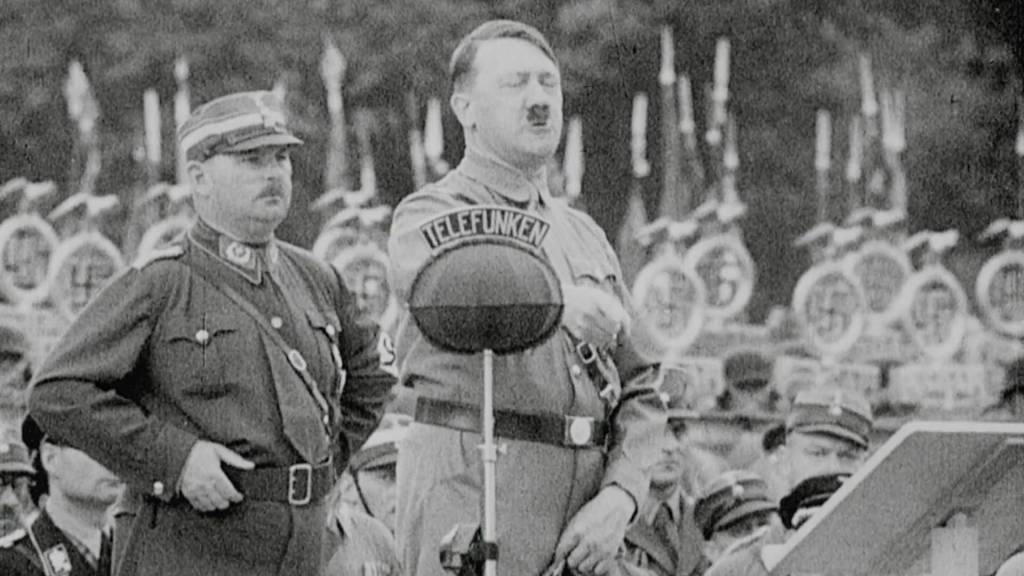
Ernst Röhm stands behind rival Adolf Hitler. (The fact Röhm is thinking about knives right now is written all over his face.)
The other thing to think about was from 1933-6 it wasn’t a given that it was all about Hitler. He had his own rivals within the National Socialist Party, notably Ernst Röhm who was essentially the party muscle as leader of the Brownshirts. Hitler needed time to secure support from the German military, and create an alternative force (the SS) before he could dispense with Rōhm in the slaughter that is known as The Night of the Long Knives. In fact support from the military was contingent on Hitler dealing with the Brownshirts, though they probably didn’t expect it to be that bloody. (Believe me things could have been worse if Röhm had won this particular power struggle …or maybe actually better because he lacked Hitler’s political acumen and might not have gotten as far)
Military power is of course the first step to securing your dictatorship. Once that is done you can turn your attention to controlling the narrative. 1934 was a watershed moment for the Nazis. With physical might on their side they could bring in their racial laws, and start openly targeting their opponents and members of the press. All classic moves we see in V with the persecution of scientists and the undermining of the integrity of journalism (Kristine Walsh) or attempts at its outright destruction (Mike Donovan). This is the beginning of the destruction of all opposition.
The next step in your playbook is to manufacture an emergency. Famously in Germany this was the burning of the Reichstag. Rather convenient for Hitler who hated Berlin and wanted to raze it to the ground and start again. (Television series The Man in the High Castle captures what Hitler would have done to Berlin perfectly had he had the chance. )
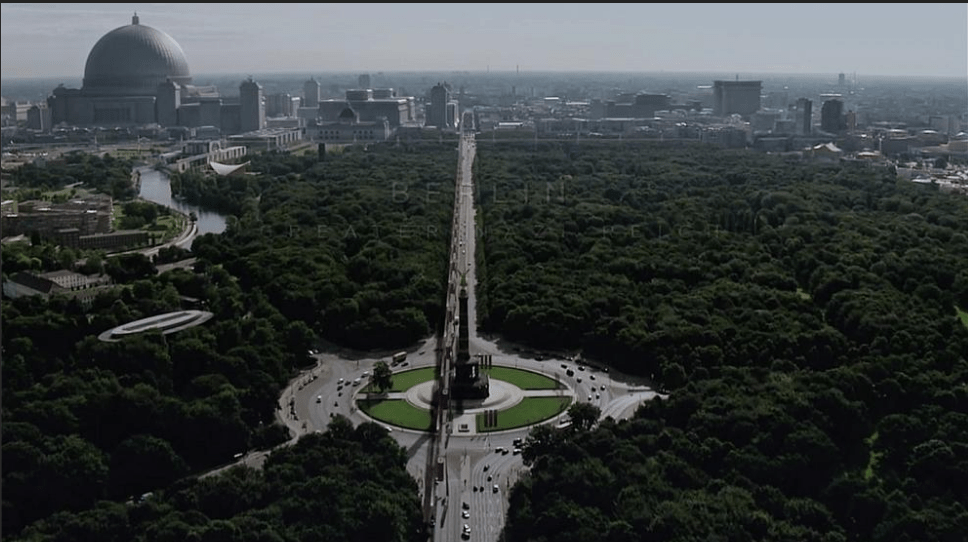
Berlin as imagined in The Man in the High Castle. On the left where the modern Bundestag now stands is the Volkshalle designed by Hitler and Albert Speer
V creates this Reichstag-like emergency in the form of a scientific conspiracy and staged street violence. All this is reified through the media. Television. Which had previously been lauded for affecting public sentiment regarding Vietnam by beaming shocking images into peoples homes. But now it is an amplifier for a national delusion.
The other thing that totalitarian states do so well is they create an atmosphere of self surveillance and paranoia. Individuals are encouraged to report on each other if they think people are somehow non-compliant to the regime. Most insidious is the recruitment of children via the Hitler Youth to inform on their neighbours or family members. Children are malleable and do not truly understand the consequences of their own actions. We see this with Daniel Bernstein who as everyone fears does inform on his family. He’s not a child, he should know better, but he’s a very young adult and very naïve. This situation tears the Bernstein family apart.
In this case the family unit which is the building block of civil society is a threat to a totalitarian regime so this is a way of neutralising it. In Germany the Party always came first.
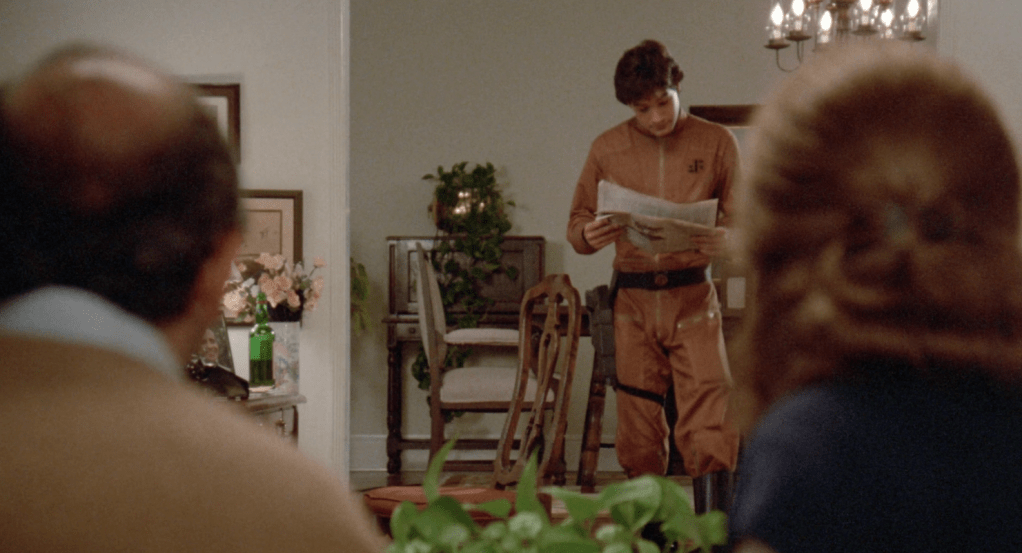
An informant in every home. Stanley and Lynn Bernstein worry about Brownshirt son Daniel.
This method of undermining people’s codes of conduct is a common move by totalitarians. This may take the form of inveigling people into doing things that are illegal, immoral or breach core values. For example the Taliban forced farmers in Afghanistan into growing opium which meant they were legally compromised and reliant on the Taliban for protection. Charles Manson made Family members engage in group and homosexual sex to ensure he had total control over the sexual availability of females and to upset the equilibrium for the men at a time when homosexuality was considered unacceptable by broader society. The point is to make people utterly dependent on ruling powers through domination of all aspects of life, including thoughts and feelings.
We will look more closely at how this kind of regime impacted individual characters in a later post (the Maxwells, the Bernsteins, the Dupres’) but there is also something to be said for how complicit some people were during this period, and how many quietly benefitted from the murder of their neighbours (which led to wholesale theft of their possessions as well as the rewards we see bestowed upon collaborators by the Visitors in V).
Moral decline is a theme that runs through the Nazi regime as they ramp up their expansionist and eliminationist policies. We’re going to look at that in more detail in the next post and how it’s depicted in V. It’s going to be grim.

Lebensraum in Eastern Europe predicated on terra nullius (or it will be once the Nazis are done with it).
 When Martin Died