
If you’ve been following this blog series you’ve probably picked up by now that during WWII there was no such thing as a monolithic “Resistance” . Resistance against the Nazis spanned numerous territories, we already mention in passing a few of these national resistance movements: French, Czech, Danish, Dutch, Yugoslav.
Within nations there were also a broad range of political movements within the Resistance. I’ve already mentioned the different political groups in Yugoslavia, and other nations such as France or Poland had equally complex political landscapes. Within France alone there were the Free French, the marquis, the communist resistance, the list goes on. (Poland is even more diverse!) I think because it was a miniseries V had to keep things simple, plus it was a stronger story at the time for Americans to see a form of resistance that cuts across race, sex, class and political views.
The other thing about resistance is that it could take multiple forms. V really focuses on methods of armed warfare, but there were numerous other methods such as production of propaganda, information gathering and sharing, espionage, non-violent sabotage and aiding POWs. Many of these methods are touched on in The Final Battle even though the main thrust of the show is guerrilla warfare. We’ve already looked at those who resisted the Nazis by proving hiding places for Jews and by providing safe passage. There is a separate blog post dedicated to these more non-violent forms of resistance while this post focuses on those who took more direct physical action.
So without much further ado let’s examine Earth’s last best hope.
Juliet Parrish (played by Faye Grant)
Juliet Parrish is one of the most interesting, and particularly for a female audience, satisfying characters to watch on V. She undergoes the greatest transformation during the show, from good little middle-class girl to tough and pragmatic resistance leader. Juliet’s character is a testament to the hidden grit that lurks within members of our society. Grit that may lie dormant for years, but is revealed in the heat of conflict.
Pressure makes diamonds
General George S. Patton
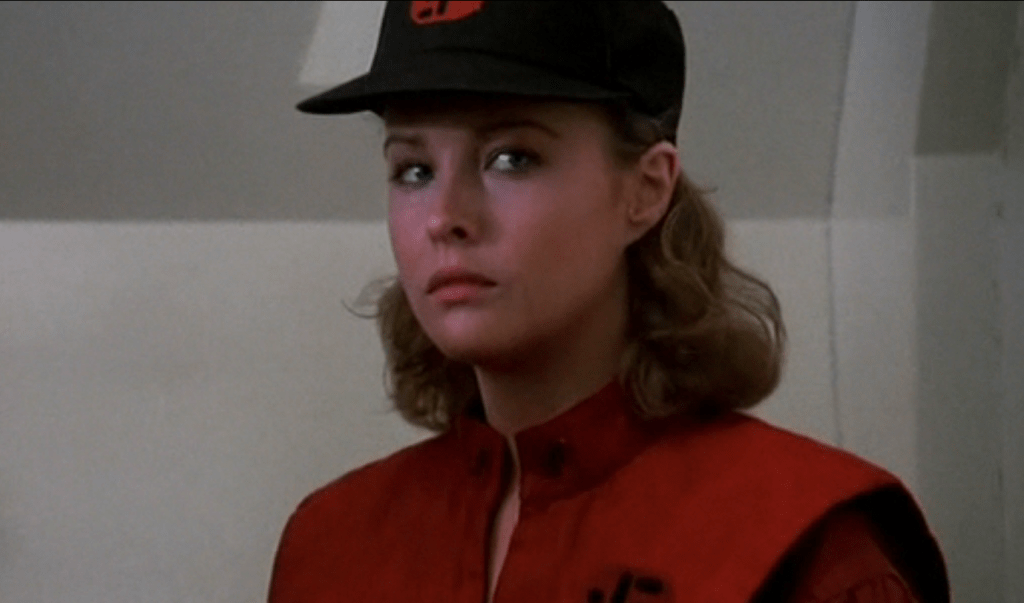
A half-converted Julie prevails against her inner demons while continuing to effectively lead her people.
Juliet certainly is a diamond. Just when you think she’s reached the edge of her ability, something even worse happens to her and she digs in even deeper. I am thinking of course of her ordeal in the conversion chamber with Diana which I discussed last week. Those scenes, show us the kind of mental toughness that is at Julie’s core (she certainly withstands torture longer than her male compatriots). What is extraordinary is that this is what emerges from a woman who is often plagued by self-doubt. Sometimes the most contradictory things about characters are the most true.
Juliet’s rise as a resistance leader happens organically. There are others who might fit a more traditional role of leadership who are captured or killed (or prove unsuitable for the role – see Mike Donovan). Colleague Ben Taylor had the makings of a leader. He was smart, handsome, and inspiring. Had events gone a different way he could have ended up in the leadership role. But people are already looking to Julie when the group first meet huddled in the dry cleaners. And it is when the Resistance moves to the underground tunnels of L.A. that it becomes clear Juliet is a leader.
Donovan: Who’s in charge here?
Brad: Well I guess you could say she is
Donovan: Who is? Her? That kid?
V

Julie shows her abilities very early on and emerges as a reluctant but competent leader.
Even in the early 1980s the idea of women being resistance leaders was unusual, which is why it is gratifying to say there are not one but two potential candidates for the historical inspiration for Julie’s character.
For Kenneth Johnson Andrée de Jongh was a strong source of inspiration for Juliet Parrish. De Jongh was of Belgian descent, and was responsible for the Comet Line, smuggling downed Allied airmen out of mainland Europe. To do this she had to escort the men across dangerous terrain through occupied Belgium, and later when Belgium became too perilous, across the Pyrenees through Spain to Gibraltar.
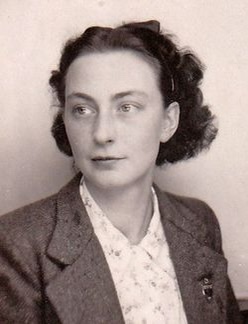
“Our lives are going to depend on a schoolgirl” an anonymous Allied soldier once said of Andrée de Jongh
The first time de Jongh turned up in Britain with a couple of soldiers in tow the British were very sceptical that this young woman could have achieved such a feat. But de Jongh went on to prove herself further by replicating these extractions dozens of times. She is estimated to have helped over a hundred Allied soldiers return to Allied territory. She was only 25 the first time she did this. At the end of the war she was just shy of 30.

Marie-Madeleine Fourcade was responsible for a network of 3000 agents.
Faye Grant points to another woman as a source of inspiration for her character. Kenneth Johnson also mentioned resistance leader Marie-Madeleine Fourcade to Faye Grant. Grant read her memoir Noah’s Ark for inspiration and even corresponded with living relatives of Fourcade. Fourcade was a beautiful and glamourous blonde Parisian who ended up taking over a cell of resistance operatives when their male leader was taken prisoner.
Fourcade went by the handle Hérisson (French for Hedgehog) which arose because the hedgehog seems an unassuming animal, but is impenetrable when it rolls into a spiky ball. Everyone in this network had an animal for a code name, thus the Nazi’s nicknamed it Noah’s Ark.
During the war Fourcade dyed her hair and wore dowdy clothes to affect the appearance of a dull housewife. She even went as far as to have prosthetic teeth fitted which changed the shape of her face. Does this sound familiar?
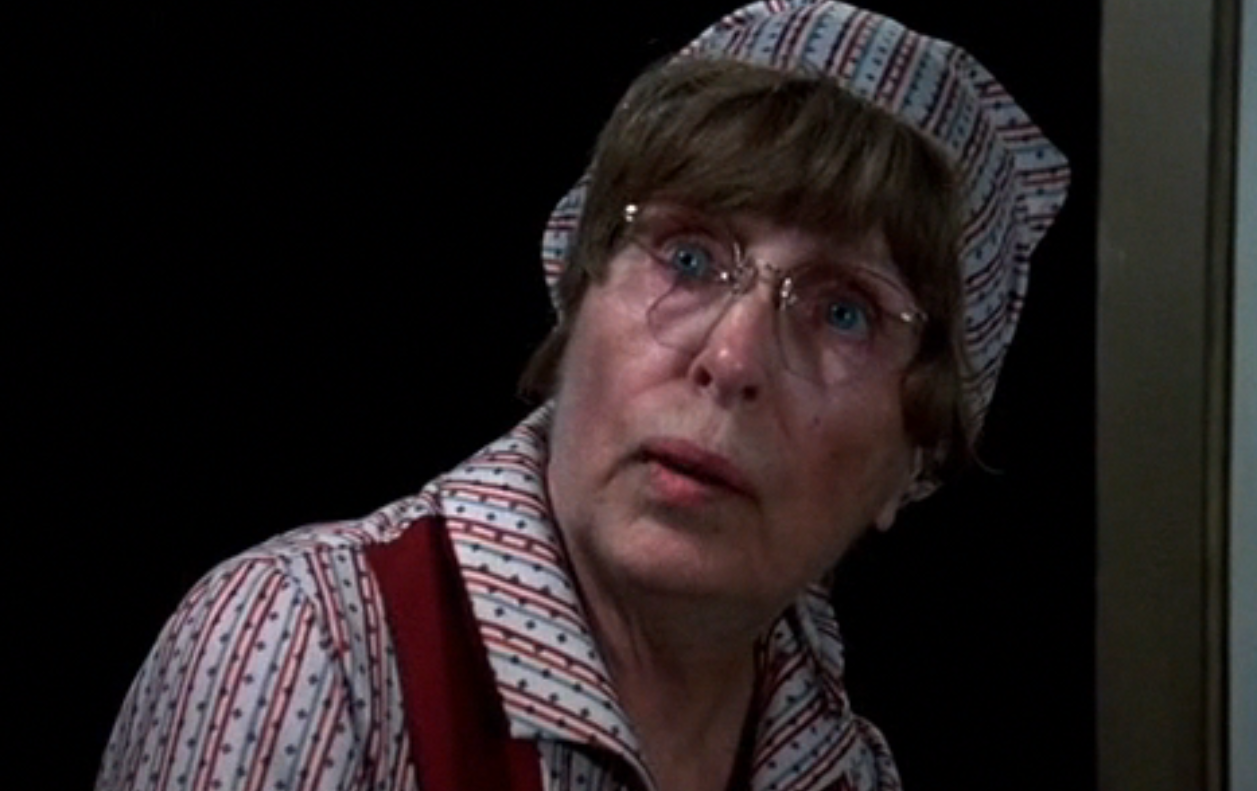
Ruby presents as a non-threatening elderly woman so she can spy on the Visitor Security HQ
These are the exact tactics adopted by Ruby Engels who was a plant in the Visitor Security HQ. (I’ll be honest with you, much as I dearly would love to write a character study just for Ruby I struggled to find a trace of anyone her age in the historical record! Fourcade is as close as it gets)
Fourcade was anything but a dowdy housewife. Like de Jongh she was only in her 20s during this time, but despite this had a way of commanding any room she entered. She earned the respect of many hardened military men. Juliet Parrish also inspires respect (and a little bit of love) from the men around her: Elias Taylor, Robert Maxwell, Ham Tyler, Mike Donovan, Martin. None of these men were pushovers, nor were they easily convinced that a young woman would have what it takes to lead a guerrilla war.
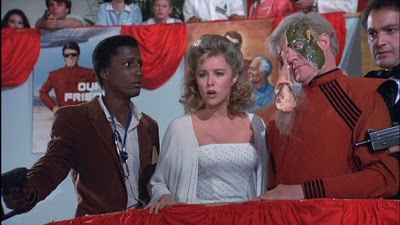
Winning hearts and minds through iconography. Juliet’s choice of angelic dress at John’s unmasking is inspired.
It is easy to see how Grant drew inspiration from Fourcade and elements of her life shine through in her performance. It is a fitting tribute.
Ham Tyler (played by Michael Ironside)
Ham Tyler represents professional military forms of resistance. Like many men in the forces across occupied Europe in WWII he would have found himself without official government leadership after the Visitor invasion. In WWII there were many governments which set up proxies in the UK and operated from there instead. Even if there is no such off-planet equivalent in V, this is another highly pragmatic form of resistance in Ham’s worldwide network: planning for a Visitor-free future.
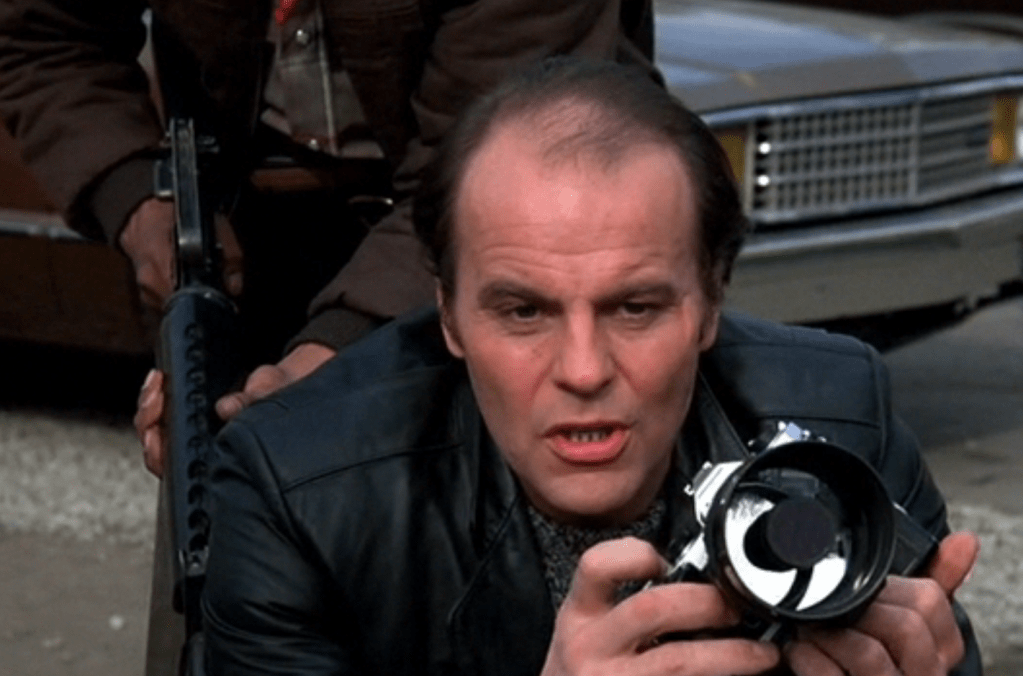
It’s fitting that Ham’s first ever line is “Move the M16 or I’ll make you eat it”
When Ham Tyler turns up in the second episode of The Final Battle he announces to this little-resistance-cell-that-could that there is a network and it is global. This network is a clear parallel to the Special Operatives Executive which served exactly the same function during World War II. The SOE was based in Britain and provided training, information and supplies to various resistance movements across Europe, conducted espionage and led a range of missions to disrupt the Nazi war machine.
Disowned by the RAF and even MI6 (which officially “didn’t exist” at the time) the SOE was considered wholly “ungentlemanly” in its approach. It drew its recruits from both civilian and military sections of society meaning some of its men and women would have considered themselves quite ordinary until they joined. SOE training helped identify those who unwittingly possessed extraordinary talent and bravery.
When America entered the war they requested the SOE share some of its training methods. These methods went on to inform the methods used by the Office of Strategic Services (OSS), a precursor to the CIA. Which is where our friend Ham Tyler works as a “black ops” agent before the alien invasion. The SOE developed methods we think of today as wholly American such as the double tap. You have to admit, the double tap is very Ham Tyler.

Tyler is completely in his element in the raid on the Visitor Pumping Station which is very similar to actions taken in Operation Grouse.
There are so many agents that Ham could be based on, it’s hard to choose just one. For example, you could point to Jens-Anton Poulsson who was the Norwegian second lieutenant who was parachuted into Norway to lead Operation Grouse, to sabotage the heavy water plant in Vemork, thus frustrating Nazi efforts to develop atomic weapons. Or he could be based on Free French fighter Joël Le Tac who was involved in an operation to destroy a transformer south of Bordeaux which severely disrupted German operations in the area. Ham could easily be any of these operatives.
But. There isn’t anyone quite like Ham Tyler. This character is so uniquely drawn and so deftly played by Michael Ironside, making Tyler so specific a character it’s hard to draw comparisons. For me it is the little touches of culture in Ham, his knowledge of wine, his interest in the theatre, that make him fascinating. This is something that only Ruby Engels notices. Ham’s refinement rests easily with his commitment to getting the job done making him someone you would definitely want to get to know more. I’ve seen some people, (including V novelists) assume Ham is a racist or sexist heel but I don’t think that is quite what’s going on. What Ham cares about most is the trustworthiness and competence of individuals. The rest he’s not bothered about. (Unless they’re lizards: they can all go hang.)
The other problem I have in placing Ham is the longevity of his career as an operative. Many in the SOE lasted only weeks or months before they were captured, withdrawn from the field or killed. (This is a problem for all Resistance fighters, and is particularly acute for the Fifth Column.) Many of the men mentioned above ended up in concentration camps or in the case of our Czech assassins from last week, and our Danish fighters Flame and Citron, died heroically in a hail of bullets. If Ham were to go out, that would be his way for sure, but he’s just so damn competent it’s hard to imagine him getting caught. That’s why he’s so damn cool. Plus he has the best one-liners.
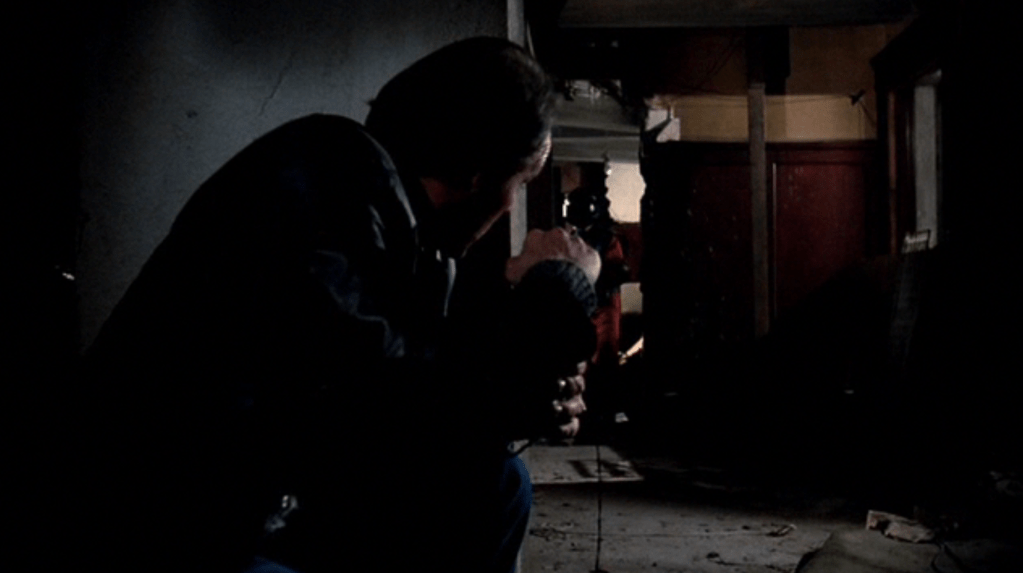
Ham about to “waste some luggage”. Yet another fan favourite one-liner.
Speaking of killing lizards, you (and Ham) will like this.
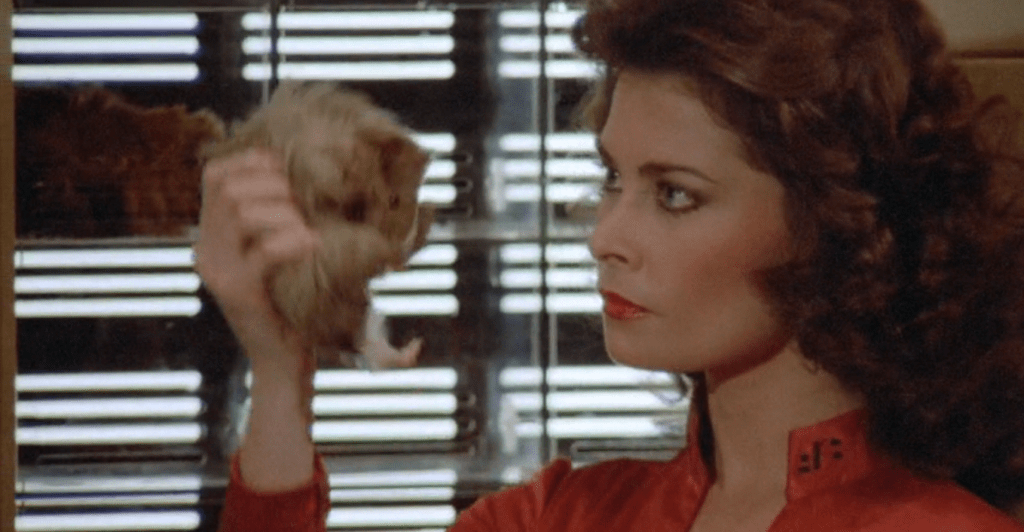
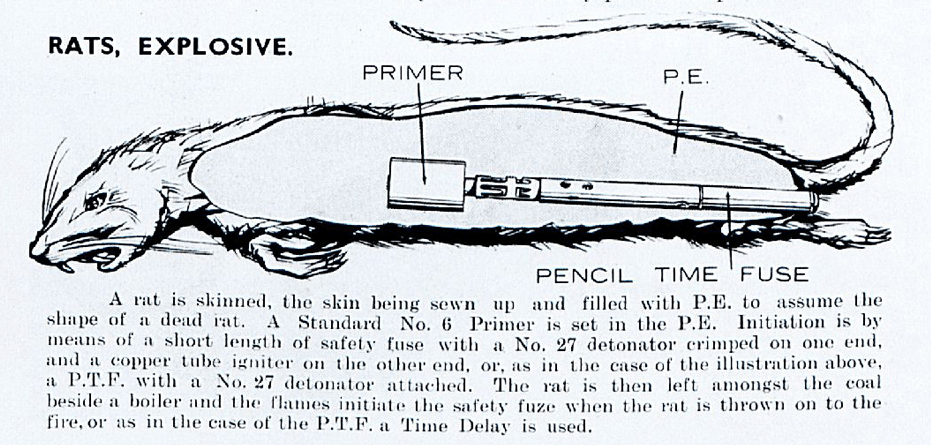
One of the tactics employed by the SOE was to booby trap rats with explosives. The rats were gutted and an explosive device was secreted in the empty cavity and the rat was left lying around in the hope the rat would be picked up and thrown in the nearest furnace – which was how vermin were dealt with at the time*. It is disputed how successful these explosive rats were, some estimate as many as nine furnaces were destroyed in this way. Others say the number was zero because the Germans knew the rats were booby trapped (but it would have been a darned inconvenience having to check every rat before throwing them into the fire).
Can you imagine if Ham had taught our heroes of The Resistance in V The Final Battle such a tactic?

Maggie Blodgett (played by Denise Galik)
The femme fatale with the crossbow! Well they got the crossbow bit right. “Sexpionage” as it is called though was not the core modus operandi for female operatives in WWII. They may have used their charms of course as distraction but that was about as far as things went. Instead women were seen as well-placed for wheedling information out of the enemy because of their communication skills, because their roles as secretaries gave them access to a lot of information and because they were easily underestimated.

Who doesn’t dig a sexy woman with a crossbow?
This aspect of Maggie’s character is absolutely right, that women would play the bimbo and use flattery to induce the most egregious mansplaining. This is much like Jeannie Rousseau (her handler was Marie-Madeleine Fourcade) who persuaded a Wehrmacht officer to draw her a plan of the rocket testing facilities at Peenemünde where V1 and V2 rockets were manufactured. Her report on these rockets was lauded as one of the most detailed pieces of intelligence of the war.
That is not to say using sex to gain access to secrets never happened. There have been instances where women have engaged in sexpionage. The most famous of these is Mata Hari who is responsible for the establishment of the stereotype. Mata Hari was an exotic dancer who was accused of using her powers of seduction for spying for Germany during WWI. The influence of her story has persisted and is perpetuated in popular culture through film, television and novels. This misdirection proved useful in the Berlin Bunker as the inner circle went nuts trying to root out a mole. Never existed, it was all the work of double agents and codebreakers at Bletchley Park. Eva Braun’s brother-in-law was shot hours before Hitler married Braun and they both committed suicide. He was executed because among other things he was thought to be passing on secrets to the phantasmal Irish spy called “Mary O’Hara”.

Sad news chaps, James Bond movies put us wrong about sexual availability of female spies!
Going back to the crossbow though, that bit is accurate. The women in the SOE received the same training as the men: handling munitions, wilderness, endurance and survival skills, radio operations, karate chopping evil Nazis. (No really martial arts was taught in the SOE.) This list goes on.
Under Ham and Chris Farber’s tutelage Maggie quickly discovers that she is rather good with a crossbow. She humbly claims “I’m no William Tell” but Ham would not have trusted her on the mission to rescue Julie if she wasn’t a crack shot.
SOE training often revealed that women could be as good if not better than men in armed combat. SOE agent Nancy Wake was noted for being “a very good and fast shot” and braver and more capable than many of the men she worked with. Born in New Zealand, and raised in Australia, Wake was described as an “Australian bombshell” who was as tough as any man. Like Maggie she was in a committed relationship which ended in tragedy. And like Maggie, Wake was a down to earth no nonsense type.
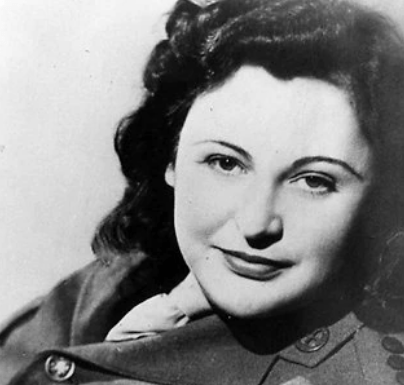
When caught in a tree after parachuting into France the local resistance leader said poetically he hoped all of the trees in France would “bear such beautiful fruit”. Nancy Wake’s response was: “Don’t give me that French shit”
That’s exactly the kind of kick-ass thing Maggie would say.
Elias Taylor (played by Michael Wright)
At the beginning of the miniseries Elias Taylor is an aimless youth who has fallen into a life of petty crime. Overshadowed by his successful brother Ben, Elias brims with resentment. It’s as if he has turned himself into a negative stereotype of a young black man as an act of revenge.
One of the criticisms of V is that the Elias character is written very broadly. It’s true this has dated badly. Not to defend white writers and producers creating poor characterisations of black people but the script does indicate these characters are putting on stereotypical acts. It seems the archetypes available in the early 1980s are Richard Pryor (brash and unfiltered) or Sidney Poitier (refined and neutered). Regardless of intent it doesn’t date so well.
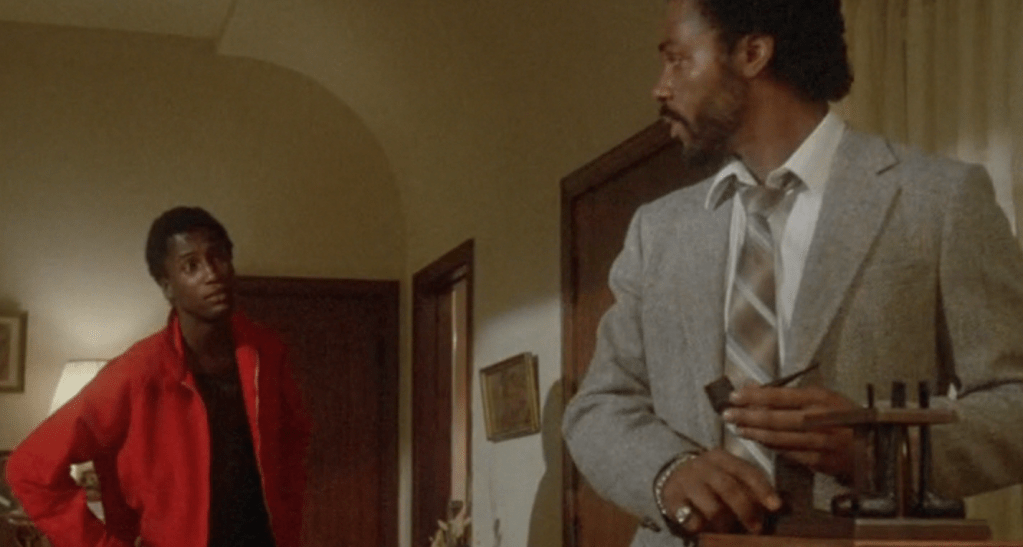
Brothers Elias and Ben are constantly at odds, having cast each other as opposing negative black stereotypes.
Beneath all this, for want of a better word “jive”, is an extremely smart and industrious young man who proves to be a force for good. I really wish I could take credit for the following idea but I can’t. Again it’s Neil and Skye from The Film ’89 Podcast who make the astute observation that Elias is a companion character study for Daniel Bernstein. Both are very young men, both are a bit lost when the Visitors arrive and both harbour some form of resentment towards what they see as pushy (but actually concerned) parents. Of the two young men, it is Elias who shows greater strength of character and finds ways to adapt the skills developed in the criminal world into useful tools of resistance.
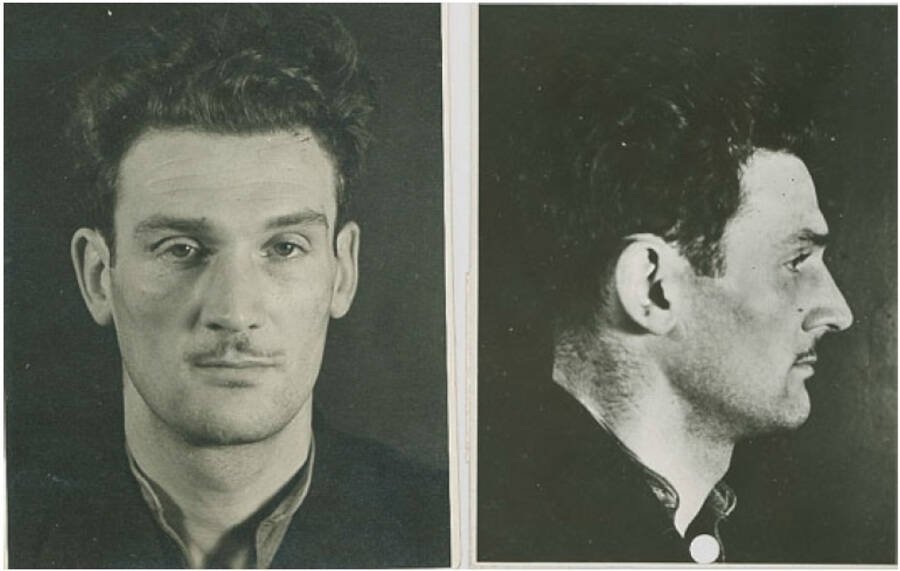
Eddie Chapman’s mug shots. As Agent Zigzag he became one of MI6’s greatest assets.
If there is anyone who Elias resembles at all it may be one of the greatest double agents of the war Eddie Chapman, codename: Agent Zigzag. (The thing is that most German secret service agents were double agents as the British managed to recruit most, if not all Abwehr agents sent to spy in Britain.)
Chapman was a petty criminal who was on the run from the authorities at the outset of the war. He had absconded to Jersey to try to escape arrest. In Jersey he was promptly taken prisoner by invading German forces in 1939, but he managed to convince the Abwehr that there was no love lost between him the British government. He convinced the Germans that his expertise handling explosives and his criminal connections in England would be of immense benefit to them, so they spent years training him to be a spy in France. But as soon as he was parachuted into Cambridgeshire in 1942 he turned himself in to the police and declared he wanted to be a double agent! Chapman went on to become one of the most valuable double agents of the war.
Like Chapman, Elias undergoes redemption through resistance. This change is noted as Elias develops into a strong and competent Resistance fighter. Even his class clown gift of the gab has transformed into more mature and persuasive oratory skills. At the end of Final Battle it is Elias who make the persuasive argument to proceed with the red dust raid despite the risk of nuclear annihilation. When his father Caleb tells him “I didn’t agree with what you said, but you said it well. I was damn proud” it is one of the more moving scenes in the whole piece.
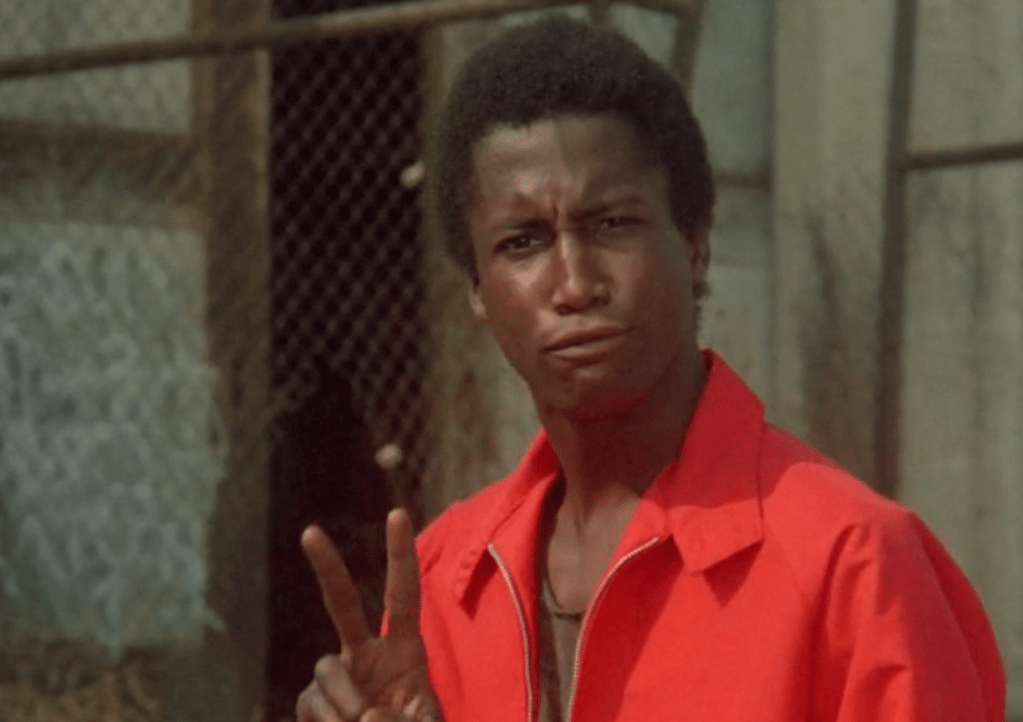
Elias is one of the Resistance’s strongest assets. Man of many talents: recruiter, saboteur, munitions expert, bringer of late night mugs of coffee and great advice.
Father Andrew Doyle (played by Thomas Hill)
Kenneth Johnson has said he has never actually watched The Final Battle, and the only scene he has seen is the one he caught while flicking through channels where Father Andrew tries to bring Diana around to the word of God. Johnson laments that the priest is played by a middle-aged actor with an Irish brogue. This was not the vision he had for this character, Father Andrew was supposed to be much younger and hipper which makes me think he was more likely to be a proponent of Liberation Theology.

It’s not Thomas Hill’s fault he’s middle-aged. In fact he is age appropriate for those who were young “hip” priests of around the time of Vatican II
Liberation Theology is a branch of theology which came to prominence in the Catholic Church after 1960. It is most closely associated with the Spanish speaking world, specifically South America as many of its most prominent proponents such as Gustavo Gutiérrez (Peru) and Jon Sobrino (Spain) arose from this area.
Liberation Theology challenges the idea that the downtrodden, the impoverished, the oppressed in life should accept their lot and concentrate their thoughts on looking forward to the afterlife. South America was acknowledged in the 60s and 70s as having some of the largest economic inequalities in the world and priests within the Catholic Church who often were informed by Marxist theory as well as Christian principles of humanity thought this unacceptable.
The South and Central American regions were hot beds of violent conflict as the countries in this region became pawns in the Cold War. Both the Soviet Union and the United States exerted all sorts of influence in this region, sometimes propping up oppressive regimes in the name of “democracy” or “equality” or whatever the superpowers were selling.
It is hard to ignore V‘s contemporary concerns with El Salvador and other countries in Central America, these are reflected in the opening scenes and in the characters of Andrew Doyle and Mike Donovan (see below). The assassination of Oscar Romero springs to mind in particular, though he never bore arms he argued for the church to intervene and speak out against the regime in El Salvador.
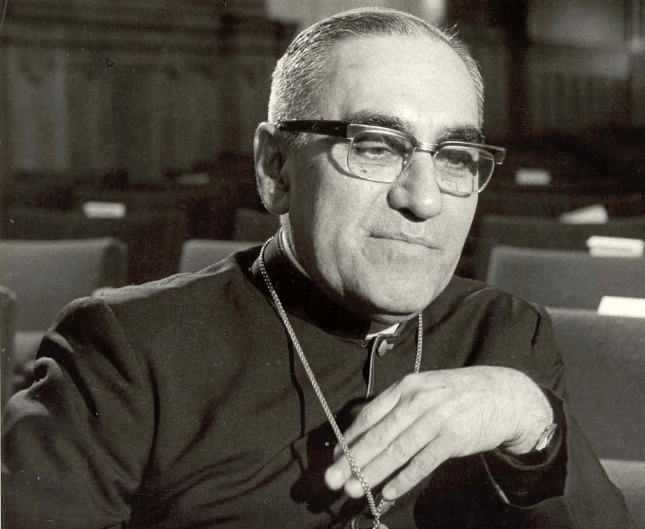
Oscar Romero was a priest from El Salvador who was assassinated during their civil war. He was not a liberation theologist but he did believe in betterment of life for the poor.
Father Doyle is a man of contradictions. His Christian teachings means he struggles with guerrilla warfare. It is a massive moral quandary for him, but how does one respond to pure evil? We’ve already seen the goodness in Ruby’s heart, and hopefulness of walking away from it. Hoping that other’s better angels will prevail. But what if there is no good whatsoever in the people you are trying to reach? Last week we learned that Jane Badler believed Diana had no redeeming qualities whatsoever. So what of Father Andrew’s attempts to introduce her to the teachings of the Lord? Were they always doomed?
Apparently not, as Ken Johnson said in the scene where Diana kills Andrew that she is truly moved, and frightened by this. If this were how it were played perhaps Father Andrew wouldn’t have looked so entirely foolish in his quest for peace through other means.
Mike Donovan (played by Marc Singer)
The very first shot in V is an El Salvadorian guerrilla leader speaking direct to camera addressing the audience. Within seconds it is revealed he is speaking to a cameraman as we switch to his perspective. We are immediately confronted with the lens of a news camera barrelling down on us like an unblinking eye. That camera belongs to Mike Donovan who is the eyes of the show.
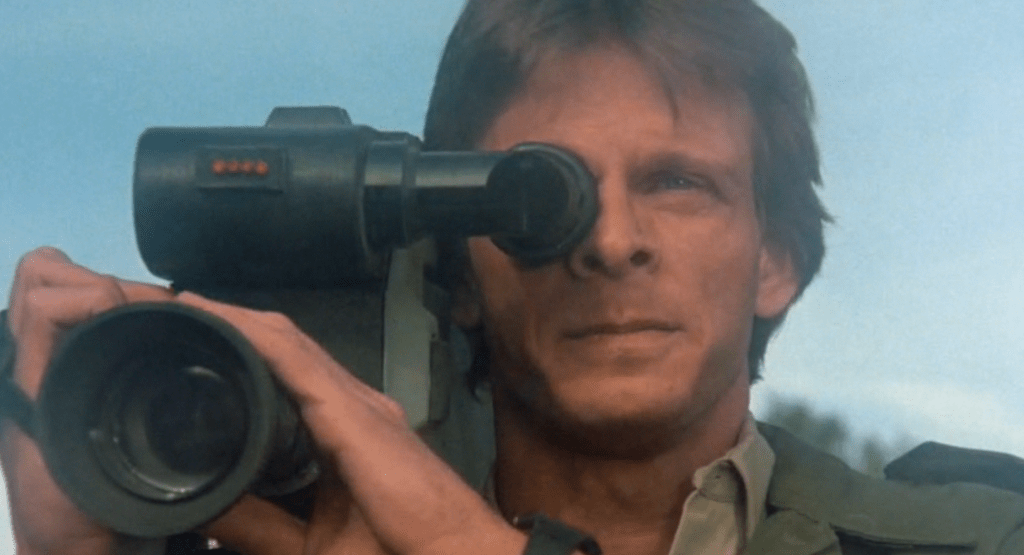
The unblinking and unflinching hero Mike Donovan
Mike Donovan is the closest we get to the protagonist of the show in this dramatis personae. His role in the show is important because it is his quest for truth that drives the plot. Without Mike we would never discover the truth of the Visitor’s motives.
Mike Donovan’s character has much more contemporary inspiration than his compatriots. Events such as the Vietnam War were less than ten years ago when V aired. As already mentioned conflict in Central America was underway, which was among other things a proxy war for superpowers who were unable to engage each other directly due to a small matter of mutually assured destruction. In this milieu the figure of the war correspondent was prominent and Mike Donovan is clearly based on journalists such as Don McCullin, Peter Arnet and Richard Boyle, who put themselves in incredible danger to report on conflict around the globe.
There are of course war correspondents that pre-date Vietnam that could easily serve as inspiration for Donovan, in particular Walter Cronkite was a towering figure of 20th century journalism. But there is another stunning example of reporting that has parallels with Mike Donovan’s mothership exposé.
Albert Wexler (writer) and Rudolf Vrba (biochemist) were two men who managed to escape Auschwitz. Virtually no one escaped from Auschwitz, this feat alone was incredible, compounded by the fact they managed to make it across hostile country to Allied territory. Together they wrote the Vrba-Wexler report which laid out in detail the workings of the Auschwitz death camp. This report had a massive impact on the Allies as it confirmed what had been previously been only suspicion and contributed to saving the lives of thousands of Hungarian Jews due for transportation.
Even more stunning is the anonymous member of the Sonderkommando who managed to take photographs of cremation of people at Auschwitz which were smuggled out in 1944 and circulated among members of the Polish resistance. These are some of the only photos that exist of the inner workings of the death camp. Their very existence is extraordinary.
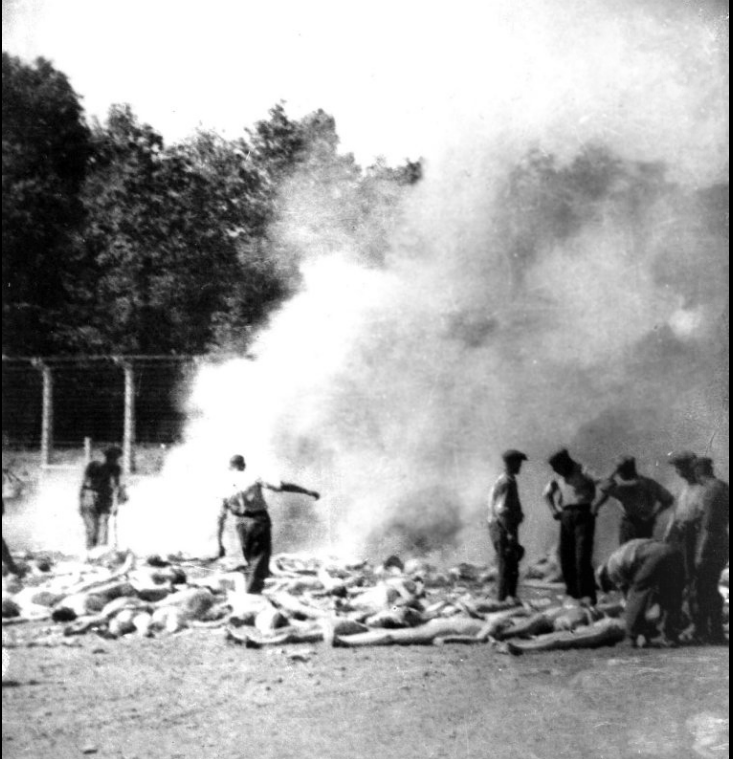
Extraordinary images of death from within Auschwitz were smuggled out and circulated among the Polish Resistance
Mike Donovan also shows incredible daring and willingness to put himself in danger making him as close to an action hero as the first miniseries gets. This is made possible thanks to the gameness of Mike Donovan, but more specifically the actor who plays him, Marc Singer who is a very talented physical actor. As the various iterations of V wear on Donovan settles into a more action oriented role which unfortunately becomes a little one-note. But in the original miniseries Mike is a much more nuanced and interesting character. He’s much more thoughtful and quotes Moby Dick. The scenes with Kristine Walsh as she tells him she has taken the Press Secretary role and the scene where he comforts a frightened Josh showcase a much more contemplative man with a rich inner life.
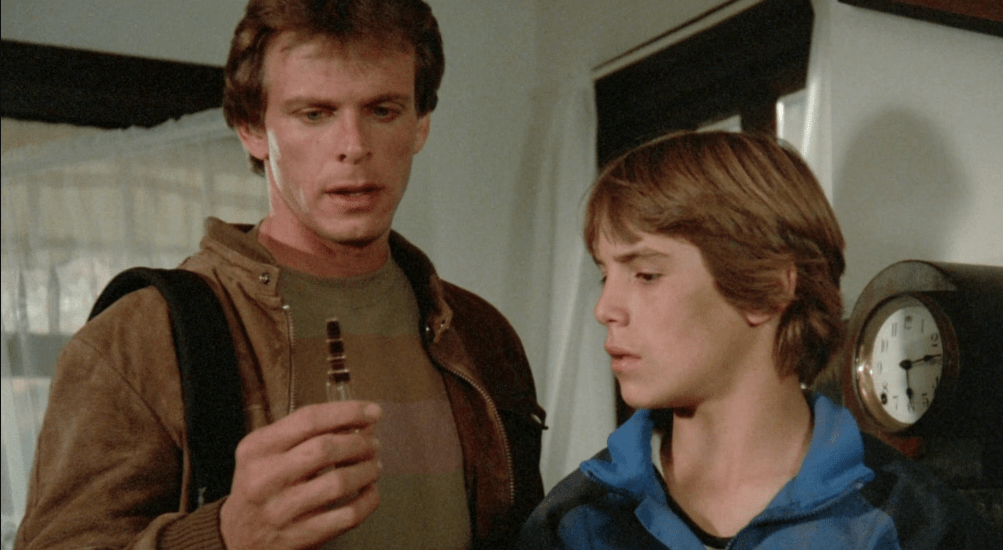
“The belly of the whale”
Mike struggles to balance the need to be a comforting adult to a traumatised Josh with his desire to throw himself into the line of fire yet again
And he’s not perfect. His personal life is somewhat messy. One can only guess how he screwed up his marriage, most likely because of his single minded dedication to the job. His relationship with his mother is also fraught (mostly her fault to be fair) and the relationship he has with the woman he is “dating” is clearly very complicated. He adores his son but how much actual parenting can you do when you’re regularly flying off to Nicaragua, Vietnam, Angola? Probably the only person Mike has a relatively easy relationship with is his partner Tony. The two men have a rhythm which belies great friendship, tolerance and trust. That’s why this is a devastating loss when Tony is captured, tortured and killed.
Clearly there is a high price to pay for being as dedicated and loyal as Mike Donovan. And then there is his temperament, which would have made him highly unsuitable as an SOE agent. I’m confident he would’ve been rejected because of his high risk lone wolf approach.
Julie: Where’d you get the uniform
Mike: On board their ship. A couple of them helped me escape
[…]
Julie: Sounds like a set up
Mike: Look lady you weren’t there okay?
Julie: Why were you?
Mike: I’m highly motivated
V
Johnson modelled V on Tolstoy’s War and Peace and like the serial novels of the 19th century used the tactic of introducing characters to the audience well before they meet each other. One of the most satisfying meetings for the audience to watch is that of Mike Donovan and Juliet Parrish. The audience has been following each character for a couple of hours by this stage so when they meet the dialogue between them crackles with the energy and weight of events that have affected each character. It is a clashing of experiences and resulting worldviews. They are such different people, each is so strong and so right but completely at cross purposes. It’s fascinating to watch.

Two great forces collide as our hero and heroine finally meet. Different forms of bravery in each but somehow they are compatible.
It does not take long for a bond of mutual respect to form between them, though (shippers will hate me for saying this) I thought it was stronger when their love for each other was not always romantic or openly expressed.
There is one other meeting of characters that brings together two equally compelling opposing forces. This is where Mike meets Martin. It’s important not just because of this remarkable friendship but also because of the series of revelations it entails.
This I will look at in our final post in the series about V and historical inspiration for characters when we look at the Fifth Column.
*This little gem I learned from Churchill’s Secret Agents: The New Recruits. This British reality show took advantage or recently declassified papers on SOE training techniques to take 12 modern recruits and put them through the paces of SOE boot camp. It’s available on Netflix and I highly recommend it!
 When Martin Died