
In the last post we looked at the shaky topic of those who collaborated with their oppressors and just how evil they were (sometimes but not always!). This week we are on much firmer ground with the perpetrators themselves where it’s much clearer: these guys are the baddies.
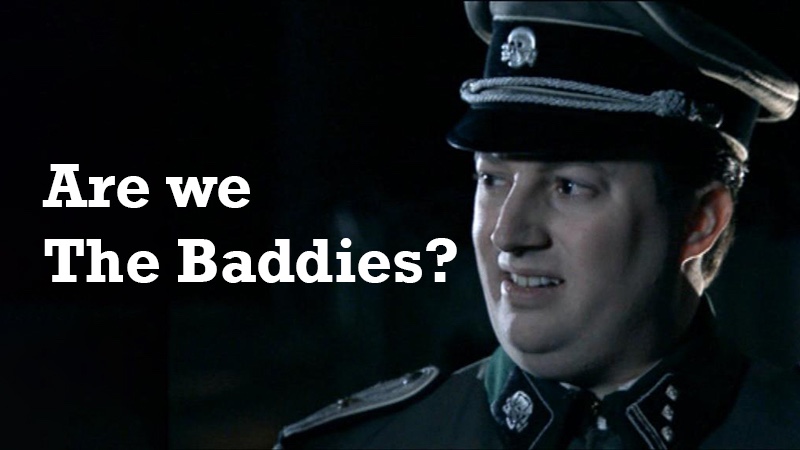
Erich the Nazi has just noticed the insignia on his hat is a rather gruesome skull and he now has some questions. (From That Mitchell and Webb Look)
For much of this blog series there has been a lot of speculation and padding around in the dark looking for historical precedents for our V characters. Most of my assertions have been accompanied with lots of caveats and equivocations as the people I highlight are exemplars of the kinds of people V was paying tribute to. This trend continues I’m afraid for John and Steven but with Diana we’ve got a live one! She’s clearly based on Josef Mengele, Kenneth Johnson has said as much in his audio-commentary. An actual historical figure! Then there’s also the unseen character of “The Leader” which is a thinly veiled reference to The Fuhrer i.e. Adolf Hitler.
The Leader (unseen character)
We actually know very little about The Leader. This is in keeping with history as those defeated and colonised often never have any sight of the people responsible for their misery. I’ve always loved the arc of the character Londo Mollari in Babylon 5 who starts out as a light relief character but becomes darker and more fearsome as his power increases. Early on in the series Londo is told by a techno-seer of a prophecy of his growing influence.
Elric: As I look at you, Ambassador Mollari, I see a great hand reaching out of the stars. The hand is your hand. And I hear sounds, the sounds of billions of people calling your name.
Londo: My followers?
Elric: Your victims.
S02 E03 The Geometry of Shadows, Babylon 5
Light relief indeed. It’s a fitting analogy for our unseen and nameless Leader as well.
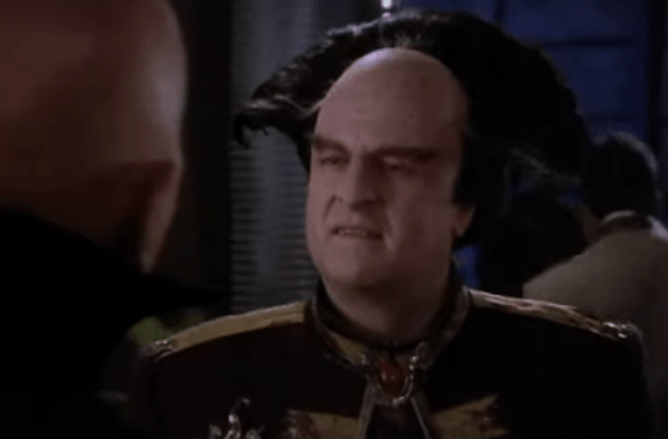
Londo Mollari learns of his fate as the oppressor of millions from the Technomage in Babylon 5
We can only go by what Steven says about him in his conversation with Diana, or what Martin tells Mike when he gives him a grim little tour of the mothership. Both of these accounts are of course going to be somewhat coloured by the opinions of the person doing the telling. But I’m inclined to trust Martin when he says that the Leader is charismatic and tells us just enough to be able to conclude that he may be greedy, cruel, and unreasonable.
We do know something about the Leader in terms of his taste in women. Pamela implies The Leader enjoys a healthy sex life and if Diana is anything to go by we can assume that he enjoys the company of many beautiful and intelligent women (and maybe also men). So while, and this is mildly disturbing, Hitler did have a sexual appeal for some women in the Reich, he made comparatively staid lifestyle choices. He only had one girlfriend and she was a very nice but very dim woman who happily lurked in the background fulfilling very domestic roles. Nothing like Diana at all.
Like Hitler however we can presume that The Leader is a demagogue able to manipulate the masses. He certainly shares the political acumen Hitler had. In one sentence written for Martin by Kenneth Johnson pretty much sums up the Nazi rise to power in the 1930s.
“Circumstances, promises, not enough of us spoke out to question him until it was too late.”
V The Mini-series
(Aren’t you glad you read all 5000 odd words I wrote on this when you could’ve just asked Martin and gotten an answer in less than 120 characters.)
But one of the enduring questions about the Third Reich was just how totalitarian was it? I know. It sounds bonkers. But historians have been arguing for years about just how in charge of everything Hitler was. Bear with me. There are two schools of thought on this. Well three, but the third one is a blend of schools one and two.
So the first theory about the extent of Hitler’s power is “Intentionalist”. This is the theory that Hitler sat at the apex of the Reich and had total control. He managed this by creating a culture of total chaos where everyone was completely reliant upon him to make any decisions. The term Intentionalist comes from the view that Hitler always intended to murder the Jews and that the Holocaust happened because Hitler intended for it to happen.

Was the Holocaust planned top down or bottom up?
Wannsee villa, site of the conference where planning for the Final Solution began in 1942 among the administrators of the Reich.
At some stage in the 80s a new theory emerged about Hitler’s power. In this second theory the Holocaust happened as a result of the very structure of the Nazi state. This is the “Functionalist” or “Structuralist” argument which states that the Holocaust happened through sheer force of momentum. The Nazi’s created a culture of anti-Semitism, an ideology of racial struggle and an environment where certain types of life had no value. In this scenario the Holocaust bubbled up from below as a result of this toxic worldview. The Holocaust was like someone leaving a truck at the top of a hill and leaving the brakes off. By the time it gets rolling it is unstoppable.
The third and most current view, put forward by historians like Ian Kershaw, and Michael Burleigh, is that actually it’s a bit of both. Hitler may have set the intention in principle, but the execution of the idea was implemented from bottom up. I think this is closer to Kenneth Johnson’s take on history. The Leader intends to conquer the human race and take the water. But he leaves the execution of his plans to the likes of Diana, Pamela and Steven. I also think all the intrigue and politics between these three is consistent with the chaos of the Third Reich.
Let’s take a look at the various people who report to our glorious Leader through the rank and file.
John (played by Richard Herd)
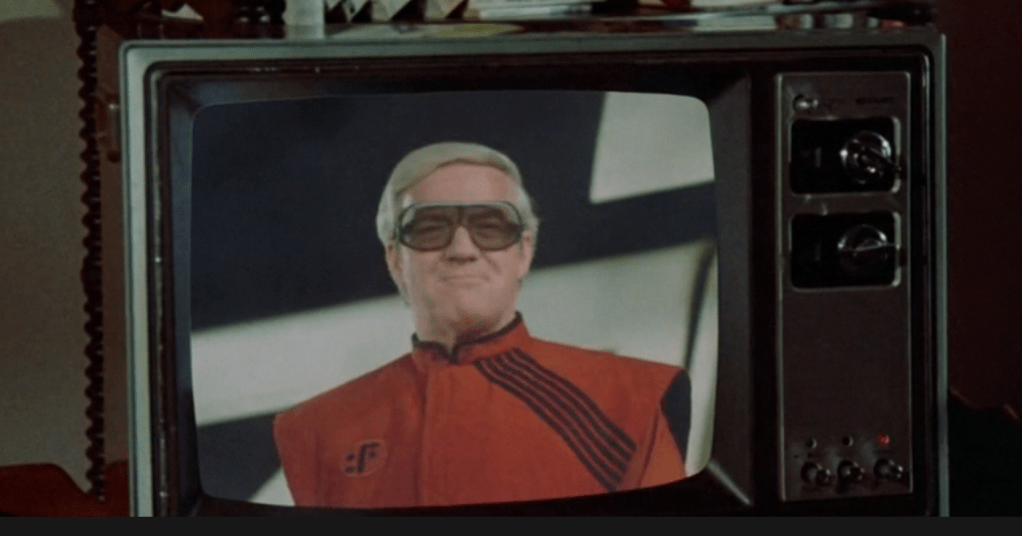
It is fitting that John is the first of the aliens we see. Richard Herd is brilliant as an unthreatening affable front for this sinister regime.
Richard Herd plays John as a charming and somewhat folksy type. He speaks with a reassuring warmth and calm that suits his apparent role to present as a pleasing front for an otherwise corrupt and evil regime. But John is nothing like the rabble-raising demagogues of the early 20th century. John’s style is more like the fireside chats of Franklin Delano Roosevelt than the ranting and shouting of Adolf Hitler. In their excellent review of V podcasters Neil Gaskin and Skye Wingfield of The Film 89 Podcast describe John as the unthreatening and warm fatherly type. With this I must agree (although their assertion that Martin was a “favourite uncle type” is far too perturbing if you had the hots for Frank Ashmore.)
John’s role is to lull us into totalitarianism. The soft spoken approach was perhaps a more fitting tone for the early 80s. Demagoguery is the most famous form of persuasion and it was very popular in the early 20th century but not so much now. Hitler was famous for ranting, an image perpetuated by numerous internet memes. But if you want to hear something really disturbing, listen to Hitler talking with his normal voice. Hitler carefully controlled his image and voice, both recognised by him as essential tools of persuasion. There does exist one recording of Hitler’s voice, taped without his knowledge which reveals something quite different to the carefully manage rabble-rousing persona. He clearly used different communication techniques depending on the audience. And different imagery as well. There also exist several official images of Hitler with children and pets and even a deer.
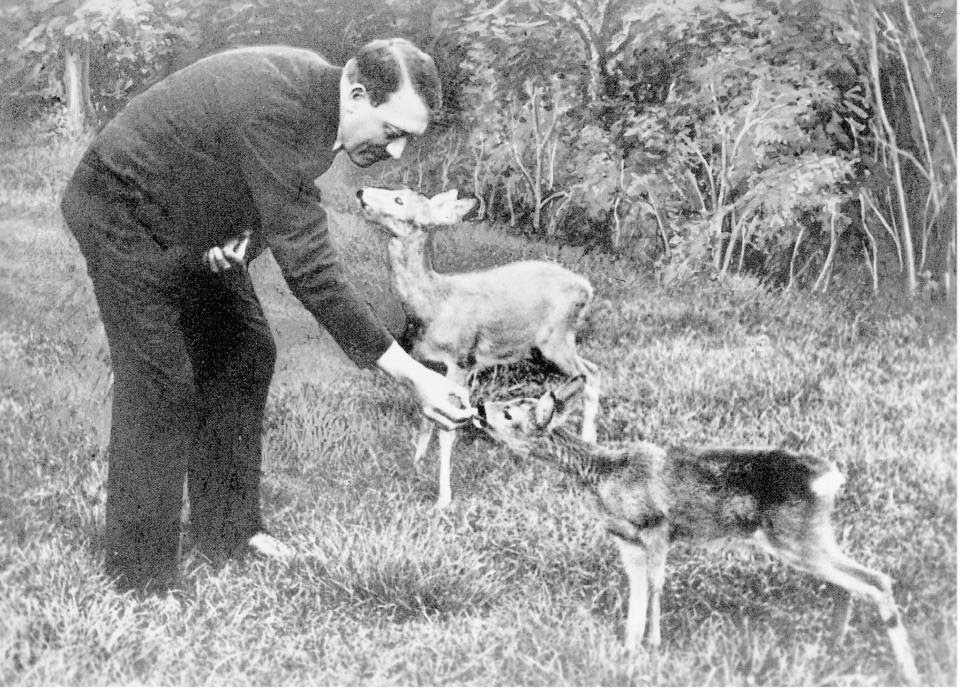
Does this mean we have to cancel Bambi now?
John’s softer sensibility is stamped all over the “Friendship is Universal” campaign the Visitors run. It is never explicitly stated that this is his idea, but in all honestly I cannot imagine Diana or Steven having much time for such things. In fact Diana says as much in the final episode of Final Battle.
The Christ-like poses John adopts at the Los Angeles Medical Centre as he accepts the applause shows us a man who revels in adulation. John is loving every second of attention in this role. It’s nice to be nice. Apparently. (Haven’t tried.) For John his unmasking on international television is therefore deeply embarrassing, this is a direct assault on the image he has so carefully crafted. The Resistance hit him where it hurts most.
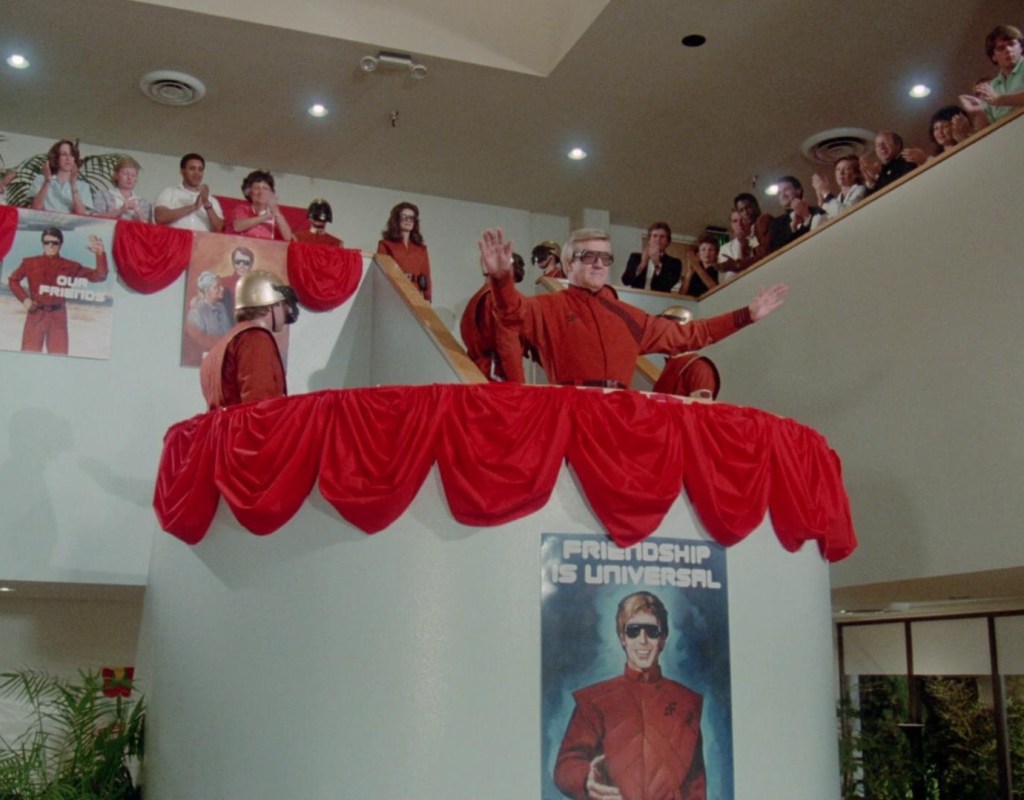
John basks in the attention of an adoring audience as he claims he is offering a cure for cancer.
It was also very hard not to draw comparisons with the president of the United States at the time V aired, Ronald Reagan. I have no desire to wade into the uncivil discourse that is American politics but suffice to say that there was a perception back then that Reagan was a superficial president because he was an actor. Theories abounded that his administration was entirely run by his deputies and he was wheeled out as a crowd pleaser. Frontman or no, Reagan was quick-witted and very skilled at deflection via humour and charm. These are very handy skills for a modern head of state. John presents as a statesman and I’m sure Richard Herd drew on many contemporary leaders to inform his performance, and the sitting president of the time may well have been one of them.
At the end of The Final Battle there is that famous denouement where Diana gives John a piece of her mind and it is seen as an ultimate act of villainy. But one can’t help but wonder if Diana’s attitude to John is shared by many of the Visitors in the military, Even his own people may see him as pusillanimous. And therefore ultimately disposable.
Steven (played by Andrew Prine)
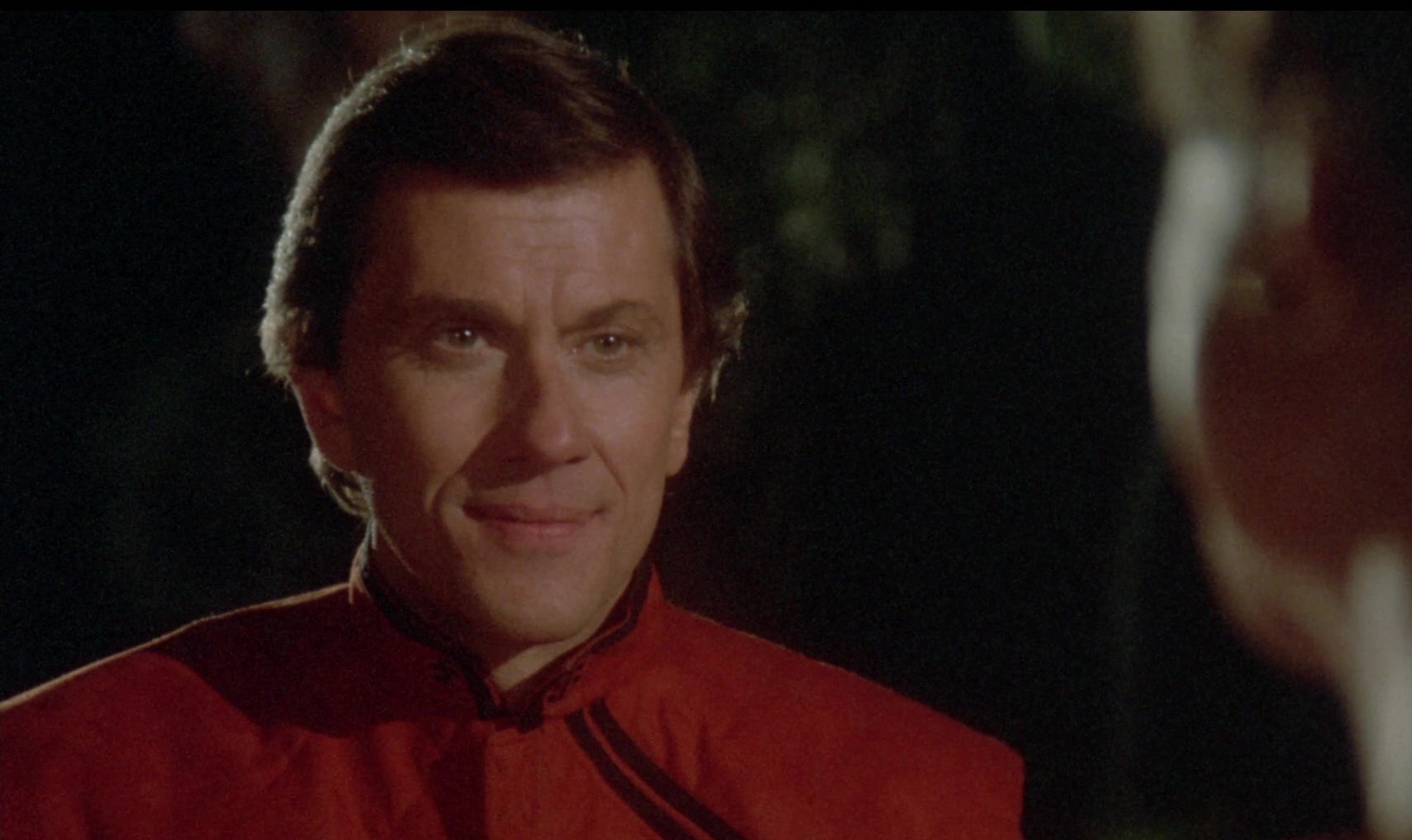
On the surface Steven is the epitome of suave. Hard working and capable he fulfills many roles in the Visitor hierarchy.
Steven is a little difficult to pin down historically as his role changes considerably between the original mini-series and The Final Battle. In the original series his role is somewhat non-distinct, he seems to be responsible for keeping up appearances at the chemical plant and pandering to the vanities of the likes of Eleanor Dupres. By The Final Battle his role is clearly stated to be Head of Security. I don’t know if this was how the role was written by Johnson all along or if this was a change made by the new creatives who came in to write for The Final Battle. Whoever was responsible for this, I think it’s a change for the better.
In the earlier series, the closest equivalent role that seems to fit for Steven is that of Gauleiter. Gauleiters were governors of regions within the Reich and it’s feasible that Steven’s role was Gauleiter for the area of California where most of our characters live. Unlike Steven, who we presume reports to John, Gauleiters reported directly to Hitler. (This was part of Hitler’s policy of creating chaos in the ruling hierarchy to maintain total control.) The Gauleiters were therefore not subject to being governed, often very independent-minded and as a result were a law unto themselves. This is somewhat unlike Steven who is very much a rank and file man.
By The Final Battle Steven is more clearly identified as the Head of Security which puts him squarely in Reinhard Heydrich territory for historical precedents. Reinhard Heydrich was the head of the Reich Security Main Office which included the dreaded Gestapo.

Reinhard Heydrich had various lovely nicknames such as “The Butcher of Prague” and “The Blond Beast”.
Hitler himself called him “the man with the iron heart”.
It is Steven that implements the food processing plants on Earth in V which has parallels with the part Heydrich had to play in the Holocaust. Heydrich orchestrated The November Pogroms (Fun fact: In Germany no one calls this event Kristallnacht anymore because “Night of Broken Glass” sounds too much like a nice euphemism where the worst thing that happened was a few shop windows got broken). The November Pogroms were a turning point for persecution of Jewish people as things moved from economic and social exclusion and punishment to much more public forms of violence. It’s never stated but it’s fair to say Steven is probably behind the “scientific conspiracy”, There’s a part of me that really wants to think he had a big role in implementing that.
Remember the wake of mass graves left behind by the Einsatzgruppen I mentioned several posts back? Reinhard Heydrich was operationally responsible for those. It is estimated the Einsatzgruppen killed up to two million people in towns recently conquered by the Nazis. He also chaired the infamous Wannsee Conference where implementation of The Final Solution was discussed by government departments.
In 1942 it was decided that Heydrich should be moved from the Prague to France where the French Resistance was beginning to make progress against the Germans. A plot was therefore hatched to assassinate Heydrich to prevent him quashing the French Resistance. On the 27th of May 1942 two Czech operatives – Jan Kubiš and Jozef Gabčik managed to intercept and bomb Heydrich’s car, injuring but not killing him.
But just like Steven, it was bacteria that got Heydrich in the end! After recovering from the wounds he sustained in the bombing he died of complications from infection. Having appeared to have recovered from his wounds, he developed an infection which led to sepsis. He fell into a coma and died, though perhaps not as dramatically as Steven did.
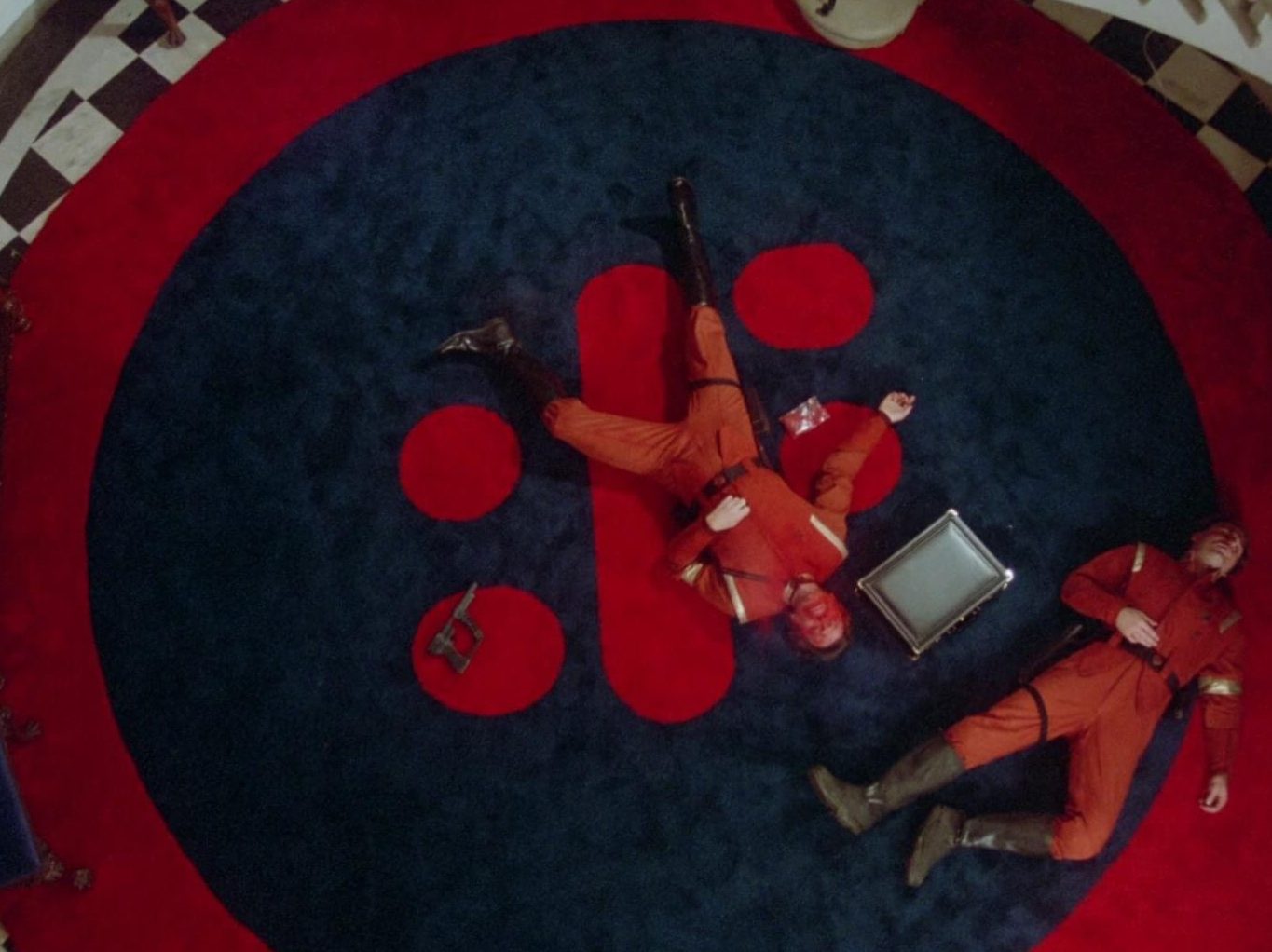
The Final Battle pulls it out of the bag for this great crane shot. Steven’s death is reminiscent of the Da Vinci drawing Man, the measure of all things.
But that wasn’t the end of it. Not at all. I think the worst thing about Heydrich is his legacy after his death. There’s the small matter of the Lidice reprisals which alone were horrendous enough. (Hitler wanted to kill 10,000 Czechs at random but was dissuaded when it was made clear the impact this would have on the war effort). Heydrich’s death also redoubled the Nazi’s commitment to accelerate plans to implement the Final Solution which was named Operation Reinhard in his honour. Which he would have liked.
Enough said really.
Unlike Heydrich, Steven isn’t completely beyond redemption. I don’t know why but I don’t absolutely dislike Steven and even find myself sympathising with him occasionally. He’s a professional and he’s gotten where he is through hard work. Perhaps it’s because he doesn’t quite have the menace and gusto that Heydrich had. Maybe that’s the problem here, I think this is a category error. Sure, Steven’s not that bad if you compare him to one of the worst Nazis that ever lived.
Diana (played by Jane Badler)
Speaking of bad.

Mad, bad and dangerous to know. No one quite tops Diana for evil genius.
No character inspires so much fear and and so much desire as Diana played by the beautiful Jane Badler. Diana is the Chief Science Officer of this mission and deputy commander to John. Based on Nazi doctor Josef Mengele she inspires terror and fear in humans and Visitors alike.
Josef Mengele was one of many doctors at Auschwitz who conducted medical experiments on humans. Unlike most doctors he actually volunteered to go there. Unusually he wasn’t using Auschwitz as a dodge to avoid fighting on the Eastern Front. By 1943 when he arrived at Auschwitz he had already served in Ukraine and distinguished himself enough to earn an Iron Cross (which he wore prominently at all times). He arrived at Auschwitz with something of a romantic aura due to his time on the Front which he frequently referred to.
Mengele was very keen to get to Auschwitz as he was most anxious to make the most of the pool of people he could carry out unfettered experiments upon. Many witnesses at Auschwitz described him as a man possessed. He seemed to be indefatigable in his mission to make scientific breakthroughs to enhance the Aryan race and give him the fame he so dearly craved. With his war service, his omnipresence and his dedication to the Reich he achieved some form of dark glamour with both colleagues and inmates alike.
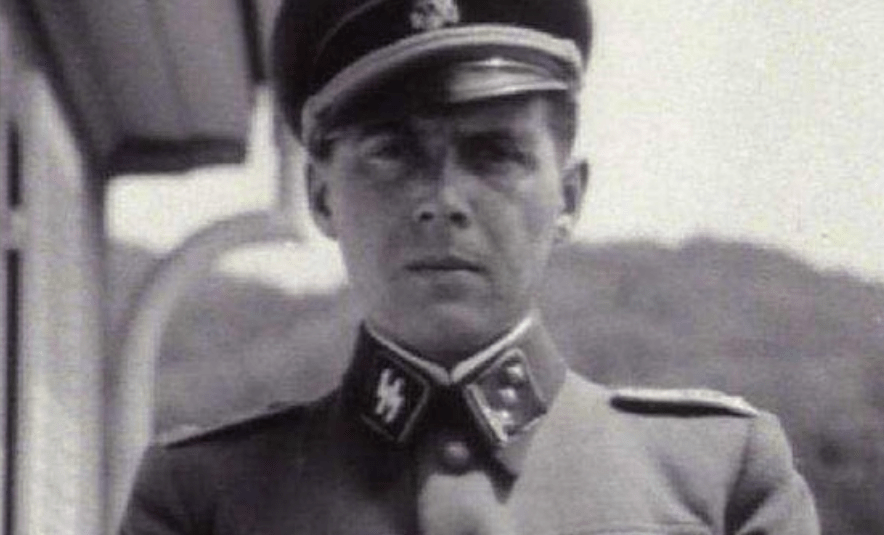
Could you withstand the cold scrutiny of Dr. Mengele?
Jane Badler channels this same evil allure as Diana, who became the subject of the confused fantasies of a generation of teenaged boys. I have to admit to being just a little bit worried for Brian when she sets her sights on him. (Not to mention Robin who is her unwitting sexual rival.) Brian is a young man and foolish so it is likely he doesn’t realise he has a tiger by the tail. Mengele also inspired such feelings among some of the opposite sex at Auschwitz. In an environment where every one was ragged and filthy he was always perfectly put together and smelled clean. It was an added humiliation for inmates to have to parade naked before an indifferent handsome young man as he coolly decided whether they would live or die.
Ironically some of the people Mengele worked most closely with were Jewish doctors. Auschwitz was a hub of talent allowing Mengele to collect people with medical and anthropological expertise from all across Europe. Mengele used these people to further his own academic career, relying on their expertise where his own fell short. The Jewish doctors at Auschwitz generally loathed him. Martin acts as a proxy for these witnesses when he explains to Mike that Diana has “authorised some medical experiments”. It’s as if Frank Ashmore went out and read every Jewish doctor’s account of Mengele at Auschwitz and poured that knowledge into one facial expression.
“How we hated this charlatan! How we despised his detached haughty air, his continual whistling, his absurd orders, his frigid cruelty!”
Five Chimneys by Olga Lengyel
Olga Lengyel was one of the doctors who worked with Mengele at Auschwitz and I think the observation that his cruelty was “frigid” is interesting in comparison with Diana who’s cruelty is always tinged with a hot-blooded sexual excitement.
The extended conversion scenes from The Final Battle are a case in point. Diana clearly gains a thrill from both toying with Resistance leader Juliet Parish and offering her comfort. I find these scenes really disturbing, the subtext here is that this is a form of rape. It had to be coded for a mainstream television audience but we know that this is what is going on here. There are other examples of sadism on Diana’s part, such as when she tortures Donovan with the truth serum. It is clear she is really getting off on eliciting all sorts of physical reactions from her (admittedly extremely fit) male victim.

Diana squares off with a defiant Juliet Parrish in what is one of the more gratuitously long torture scenes in 80s television.
Mengele did have his moments. He liked everything around him to be perfect which meant many of the female inmate doctors he worked with were pretty. And it is reported that he did enjoy exploiting the doctor/patient power dynamic, often asking pregnant women lewd or prurient questions just because he could. But Mengele was actually driven more by his ambition than his libido (whereas for Diana it’s both). His cruelty was coldness. He could be tremendously unfeeling toward his victims.
For example: Mengele was appointed as Chief Physician of the Gypsy Family Camp, one of the few areas in Auschwitz where children were allowed to live. He had a great affinity for the Roma, offering treatments alongside his experiments, and often brought sweets for the children for whom he even built a kindergarten. When the order came down to liquidate the camp to deal with a typhus outbreak, he disagreed with this move vehemently, but nevertheless acquitted the task thoroughly. It is alleged that when one little girl pitifully begged him to save her life he responded “Oh won’t you shut your little trap”. He then signalled to a kapo (a block leader) to dispatch her, which the kapo did by brutally throwing her under an oncoming truck. She was four years old. How Mengele could so quickly turn away from people towards whom he had previously been affectionate enough to earn the nickname “Uncle” (there’s that word again) I can’t even imagine.
Mengele was not sadistic like Diana but he was incredibly cruel in an entirely different and chilling way. The truly horrific thing about Mengele was that he was able to conduct Selektions (sending people to the gas chamber) with relative ease. He was one of the only doctors who did not need to get drunk to do it. In fact he often volunteered for extra duties so that he could find more subjects for his experiments. As for the Selektions themselves, he appeared to enjoy himself as he waved people to their deaths. His countenance was always genial, often whistling an aria or joking to himself as he worked. In this way he is like Diana, who Martin tells us enjoys torture. But enjoying conducting Selektions is not the same as enjoying torture. Especially if you believe you are being humane.
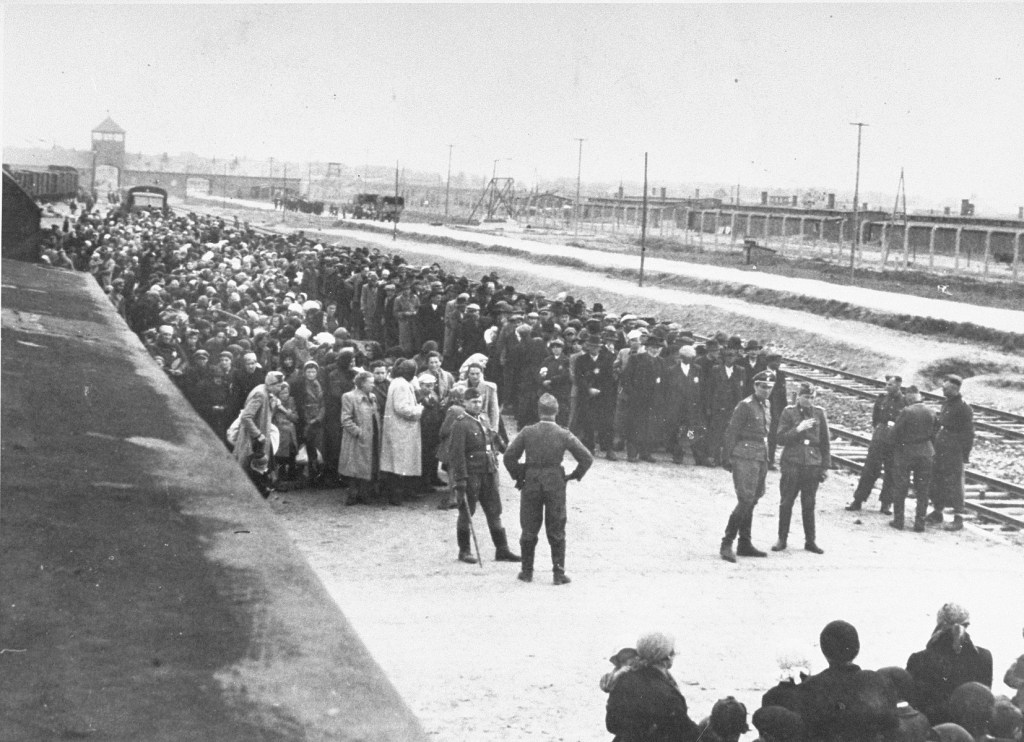
Most doctors had to get drunk to perform Selektions, some were so paralytic they could barely stand upright. But Mengele was always content in his work during this task.
One of the key differences between Diana and Mengele is that Josef Mengele actually thought he was a great guy. No seriously. He thought he was a good person because, for example, when he saw a child who had a mother who was fit enough for work he erred on the side of sending both to the gas chamber together. His rationale for this was that he was sparing the mother the grief of the loss of her child.
What a peach.
His life is full of such instances of unjustified high self-regard. If you read Mengele’s post-war memoir it reads like a John Le Carre novel where he is the hero of the story. Little mention is made of his wartime activities, he seems to have no lasting trauma from this time and he is the hero of his story who is unfairly persecuted for nothing more than being on the wrong side of history. He called his memoir “Fiat Lux”. (“Let there be light” Genesis 1:3)
Just a dash of hubris.
Just a smidge.
Diana on the other hand doesn’t have any illusions about being a good person. She is an unapologetic villain, rare for female characters as women are socialised to “be nice”. In this way she is a very well written alien, unfettered by human female socialisation. This difference from the historical figure upon which Diana is based I think is partly intentional but I think also had a lot to do with popular perceptions about who Josef Mengele was in the 1980s.
At the time V was made Mengele occupied the role of the ultimate Nazi bogeyman. In the early 80s it was not known that he was already dead and efforts to bring him to justice were still fervent and varied. After the capture of Eichmann in 1960 groups of government and private enterprises got involved in “Nazi hunting” and Mengele was the top of the most wanted list. Because he evaded capture a mythology arose about him, stories permeated the zeitgeist about blue eyed Indians in the Paraguayan jungle and cadres of neo-Nazi bodyguards ruthlessly murdering any Nazi hunters who got too close. Films like The Boys from Brazil and Marathon Man depicted him as a diabolical force impossible to take down. What nobody knew was that the reality was by the end of his life he was a sad, paranoid old man shuffling around the rougher suburbs of São Paulo.
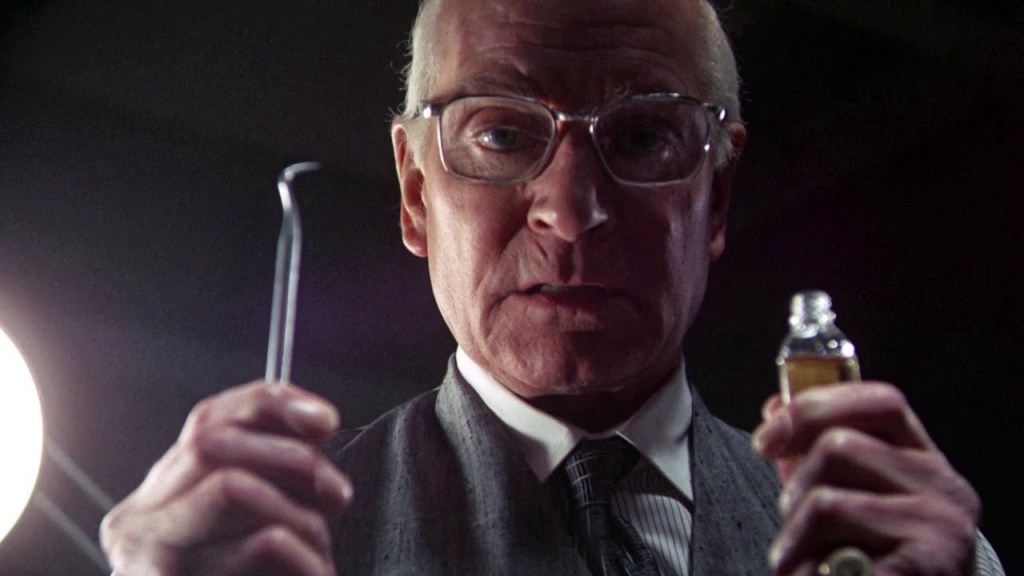
“Is it safe?”
Sir Laurence Olivier plays der weiße Engel (White Angel) in Marathon Man based on Mengele.
This mythology, which started in Auschwitz totally permeates the character of Diana. She is pure evil, at least in the first mini-series. Her character speaks little, conveying darkness through her eyes. (Which is famously why Jane Badler got the part). In the original series this Diana is fire and ice. She is a hotly passionate woman. But she also emanates a cold and detached cruelty as well. Consider the scene where Diana proposes to Brian he take part in an “unusual medical experiment”. With Brian Diana is both very cold, but also enjoying messing with Brian as much as she is with Robin. Her very whims are dangerous, her mere presence is malignant.

Brian is a silly young man if he thinks this encounter with Robin (and Diana) will end well for him.
But as the series progresses this cold facade slowly wears away. We are allowed greater access to Diana’s inner world which I think is a massive mistake narratively. As is the decision to show us the conversion process, which was far more terrifying as an unknown quantity. It’s golden rule of horror not to show the audience too much. Familiarity undermines the terror.
This Diana softens over time, as she is thwarted by internal intrigues during Final Battle and is totally camp by the time of the unmentionable weekly series. It’s such a shame but you know what? It’s also consistent with the way in which men like Josef Mengele are depicted as cartoonishly awful versions of themselves. And. It’s dangerous to sensationalise, ridicule or downplay this evil.
That’s kind of the point of the show.
 When Martin Died