
Welcome to the first of a series of posts discussing history and V the original mini-series and V The Final Battle. Over the next few weeks I will be looking at V and history with particular focus on the Third Reich which is undeniably a major influence on this work. In this first post I’ll talk about the context in which the Nazi state arose. This is a period of history I’ve spent a lot of time studying. I’d like to say this is because of V but if I’m honest I was interested in history generally and Nazi Germany in particular before I got into V.
We’re going to start this post by contemplating Napoleon’s hat. Relax! It’s okay, we’re still in Germany at the Deutsches Historisches Museum in Berlin. The exhibit is quite fun as the hat is suspended in the air at the height at which it would have sat on Napoleon’s head. This means you get to stand next to the hat and imagine your own stature in comparison to the diminutive Corsican yourself. (This is quite satisfying if you yourself are short.)
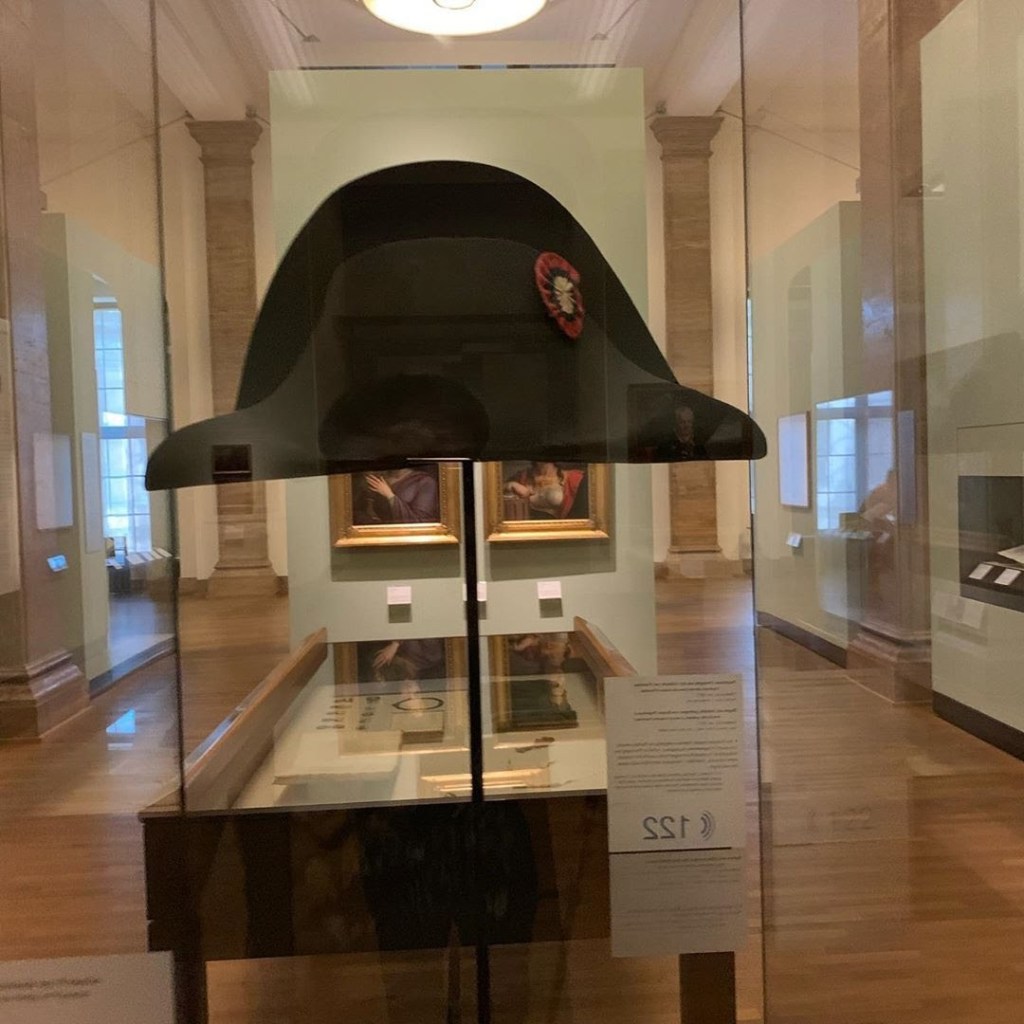
Do you measure up?
Napoleon’s Hat at the Deutsches Historisches Museum
Why Napoleon? Well this is because the Napoleonic Wars were kind of a big deal in the 19th century. This was a major conflict essentially about who got to rule Europe. The Napoleonic Wars covered a period from 1803-1815, following on from The French Revolution which all together had been an extremely disturbing and upsetting event for most countries looking on from the outside. (This was because a mob practically hunted down the aristocracy and reveled in melodramatically cutting their heads off in public, which is admittedly rather unpleasant.)
The Napoleonic Wars drew in combatants from all over Europe as the war raged across the continent ultimately reaching Russia. This war provided a very exciting backdrop for many works of literature at the time: War and Peace, Vanity Fair and The Count of Monte Cristo just to name a few.
So there’s a story (from Brian Boyd’s excellent biography Nabokov: The American Years) about how Vladimir Nabokov would teach his American students about Russian literature. The story goes that the students are sitting there in a darkened lecture theatre as Nabokov calls out the names of great Russian authors, Pasternak for example and turns on the lights for a section of the theatre. He goes through each author in this manner one by one scattering light here and there across the lecture theatre. Finally he says with emphasis: “Tolstoy!” and floods the whole room with a dazzling light. The point being that Tolstoy has everything.
If you were unkind you might say Tolstoy had a kitchen sink approach to writing. But I say he’s a completist. And one important thing about Tolstoy is that he was obsessed with history. So much so he gives over the Epilogue in War in Peace to his theories about history. Among these theories Tolstoy said that you cannot make sense of war, especially if you’re fighting it. And Tolstoy also picked apart the Great Man theory of history, which is the idea that history is driven by the actions of powerful and great men: Alexander the Great, William the Conqueror, Charlemagne and of course Napoleon. Instead Tolstoy thought there were multiple factors with multiple actors each with their own motivations leading to a complex web of actions.
Causation is one of those key concepts in history, basically the theory that one event leads to another, or causes something else to happen. There’s also a whole other thing about history being a progression where things generally get better – it’s called Whig History and has drawn heavy criticism for various reasons (There’s also the now very much forgotten since the fall of the Berlin Wall Marxist theory of history that society goes through evolutionary stages. This is also … problematic for [reasons].)
As an example of causation applied to history, the punitive reparations that were placed upon Germany at the end of the First World War via the Treaty of Versailles is seen by some as one of the causes of the Second World War (because it gave rise to a number of anti-Treaty of Versailles populist movements in Germany, one of these being the National Socialists). But not everyone thinks that it’s that simple – there isn’t always a straightforward cause and effect. Plus it’s easy to come in with 20/20 hindsight and say “this led to that” but how much are we shoehorning things into a narrative series of events to make them simpler to understand? Tolstoy doesn’t believe this is exactly a true history and instead presents something that is more of a mosaic.
Essentially history itself is a construct. And it’s a construct used to understand our present as much as our past. Much like speculative science fiction. This is partly because humans are creatures that understand things through narrative; story-telling. But also partly because history, like everything else is there to serve the powerful. In fact history is as much a tool for ignorance and dominance as it is for enlightenment and inspiration.
Kenneth Johnson has said on many occasions that before making V he had just read War and Peace and that influenced how he wove together the stories of so many different characters in V. In fact the original miniseries V has the structure and character set of a 19th century serialised novel. Tolstoy was notable as being one of the first novelists to bring together domestic stories centred around families with the much more epic landscapes of war and history. Tolstoy is both omniscient and absent, often interrupting the flow of the text to explain history, and sometimes just stepping back and letting things happen. This influence is clear in V as Johnson also switches between explaining larger plot points often through television screens (ironically small) and then filling in the details through character interaction.
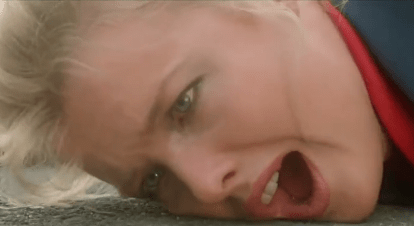
A fallen Juliet Parrish coming to grips with her harsh new reality.
The other key similarity between V and War and Peace, is the beautiful convergence, not just of characters but of harsh realities. At the beginning of War and Peace the Napoleonic Wars are distant, a bit of a lark, an opportunity for adventure for the young male characters. By the end of the novel the French are approaching Moscow and the homes of those men and the families they love are now burning to the ground. There’s a sense of “how did it come to this?” as in V where fascism creeps up ever so slowly, in increments. You can almost see this thought-process flickering across Juliet Parrish’s face as she gets shot in the hip while stealing medical supplies. Only a month before her life was more than comfortable. But here she is lying injured on the ground wondering “How is this happening to me?”
So there’s another reason I would love for you to visit the Deutsches Historisches Museum (and Berlin in general). It is so that you could get an opportunity to soak up the totality of German history, which is admittedly very complex and stretches back to Roman times. To British eyes this museum history looks strangely familiar. The geographies of Britain (an island) and Germany (smack bang in the middle of Europe) dictate very different destinies but in some ways it’s almost like the two countries are alternate universe versions of each other.
German society was highly enlightened, the culture was very rich. The literature. The philosophy. The music. And Germans had (and currently have) a reputation for being a phlegmatic people. Germany was a relatively safe place to settle if you were Jewish, compared the Eastern Europe which was the original “Beyond the Pale”. People of Jewish heritage had often fully adopted Christian German ways of life, sometimes to the point where many had abandoned their religious and cultural connections entirely (like converting to Catholicism – gasp). Which is why The Holocaust was for many a massive betrayal. So many Jewish people went a very long way to assimilate and even then it wasn’t enough. (For more on this topic among others I would highly recommend Simon Schama’s documentary The Story of the Jews.)
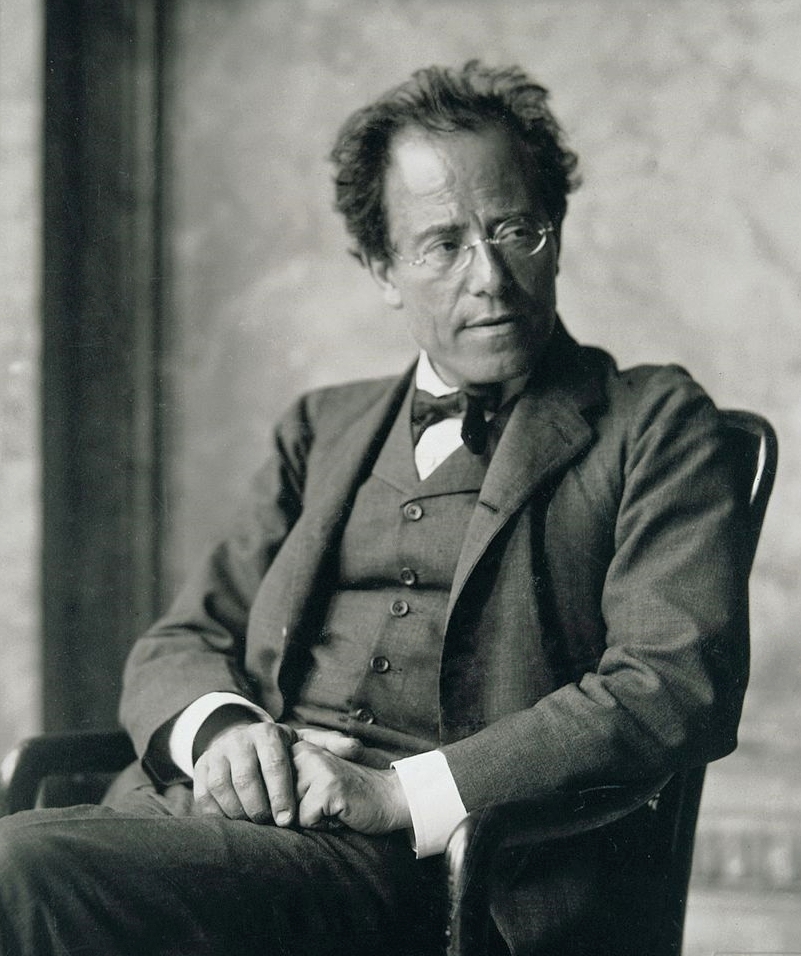
Austrian composer Gustav Mahler converted to Catholicism to appease his anti-Semitic wife. His music was nevertheless banned in Nazi Germany because of his Jewish origins. (His niece Alma Rosé directed the prisoner women’s orchestra at Auschwitz-Birkenau before she died there in 1944.)
So why did Germany lose it’s damn mind then? “Circumstances, promises?” Well. It’s complicated. But this is where I think V helps us to understand how fascism could happen anywhere. And there were some issues that were peculiar to Germany in the early 20th century which I think were additional factors.
Firstly let’s explain that “Germany” as we know it today is a bit of new thing. Before 1871 when the modern state of Germany was established, Germany was a complicated web of principalities and states, some of which were vestiges of the Holy Roman Empire. (German history is complex but for those wanting an easy to read primer on the topic I would highly recommend The Shortest History of Germany by James Hawes)
Being in the centre of Europe, roughly between the Rhine and the Oder – boundaries set out by the Romans – has meant Germany will always have to deal with two fronts which is a precarious defensive position. Germany has had to consider many methods for neutralising their neighbours. (You could argue the EU is the latest defensive tactic undertaken through non-violent means). Geography has awkwardly cast Germany this role.
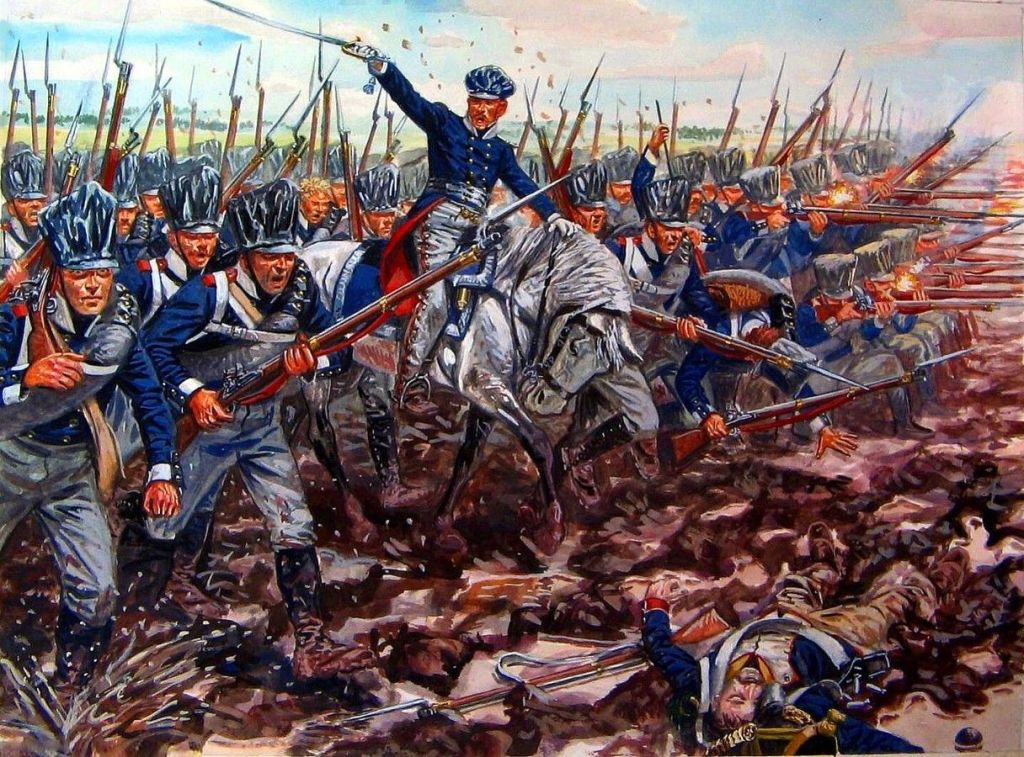
Prussians at the Battle of Waterloo
But there are also advantages to being in the middle. Such as the opportunity for expansion. Germany’s territorial ambitions actually pre-date Hitler, as she looked wistfully eastwards. Germany was what the British would call “Johnny-come-latelies” to the Colonialist table. In some cases as many as four hundred years after other European colonisers, there wasn’t much territory left to claim by the time Germany happened along. In addition to all this, Prussia had enjoyed cultural dominance in the time leading up to the formation of the German state. Prussian culture was highly militaristic and aristocratic. Prussian Germans feature heavily in War and Peace as people who believe that war can be interpreted as if it were a science. A claim that Tolstoy, of course, strongly refutes.
So on the eve of the Great War this is a country that has a bit of a chip on it’s shoulder. I think with the recent 100th anniversary of WWI there is enough out there for us to understand just how horrendous this war was for all parties involved. I don’t need to go into it.
This brings us to the beginning of the Weimar Republic which became a breeding ground for fascism. This we will consider in the next post.
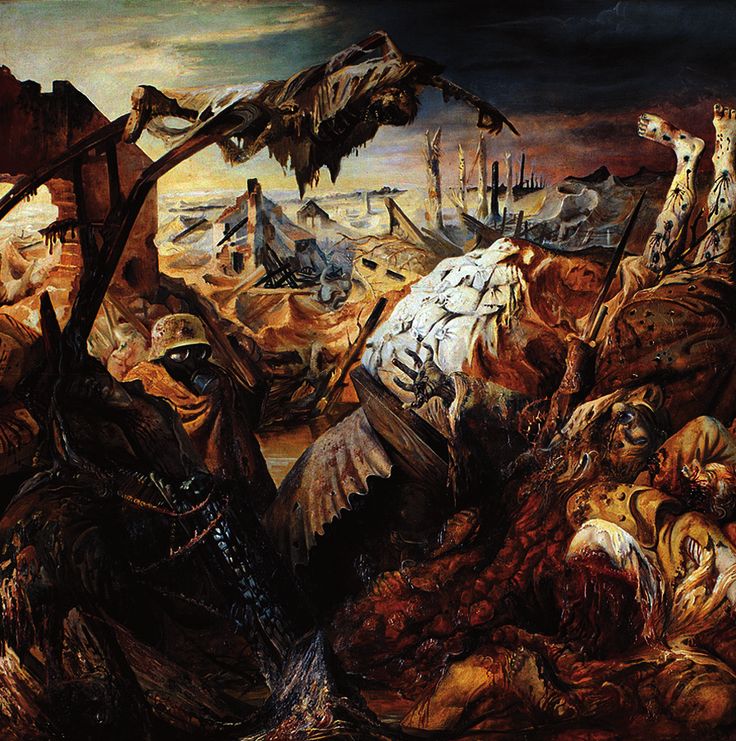
War is horrendous
Der Krieg by Otto Dix
 When Martin Died